Adam recently wrote how “You can no longer safely assume that your product will stand alone”, and how it needs to recognize the ecosystem in which it is placed.
This accords with my “Stop Designing Products” presentation (which I’ve since updated and gave at UIE’s Web App Summit).
There are two ways that products can take advantage of systems. The more obvious way, which Kodak pioneered in the late 1800s, and which Apple has executed of late, is to control all aspects of the system, and parcel functionality where appropriate. In my talk, it looks like this:
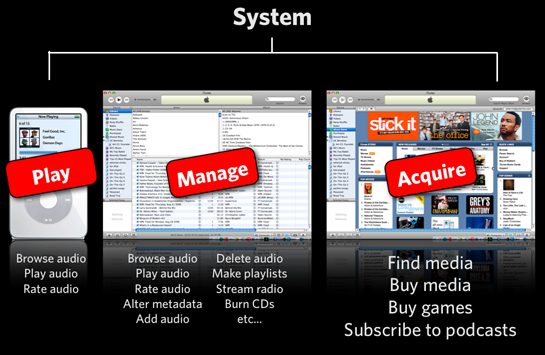
Few of us have the ability to control a system in such a way. When Adam says that your product will not stand alone, he’s talking about the reality that so many things are going to be out of your control. Still, a systems view of the situation can help you develop a successful product. Take digital photo sharing. The success of Flickr is how it fits within an existing digital photo ecosystem, and adds value by helping coordinate these disparate elements of the ecosystem.
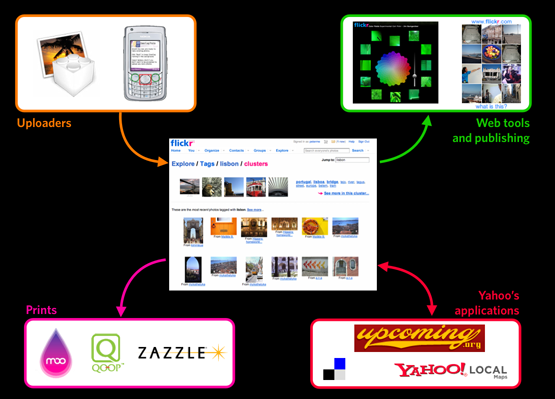
The challenge, which Adam’s comment suggests, is that product designers tend to focus on the stand alone. They tend to get so wrapped up in the Thing they are creating that they lose site of the environment in which it will be placed. For further reading, I suggest The Other Adam’s Why Designing Systems Is Difficult.
Now, why is this systems view important? Well, it ties into the other thing I’ve been thinking about, which is how we need to take an experiential perspective in our product development. If you want to deliver on an experience, as opposed to simply a set of features, it’s becoming clear you must take a systems view. When Eastman launched Kodak, he pledged, “You push the button, we do the rest.” When Apple launched iPod, it wanted to deliver the experience of ‘A thousand songs in your pocket.” Delivering on these promises requires going beyond any single component toward appreciating how an entire system can be orchestrated to deliver this experience.
Brandon’s post on Target’s ClearRX demonstrates this brilliantly. There as a desired experience (exemplified in the redesigned pill bottle), and that required a massive restructuring of systems in order to deliver it.
Anyway, these are among the things I’m thinking a lot about. I’d love any pointers for further reading on such topics.

