Bloglines *is* picking up my Sandbox RSS Feed. Thank you and good night.
Category: Uncategorized
Bloglines still not picking up Sandbox RSS feed
Even though the feed for Sandbox is current:
http://feeds.feedburner.com/DesigningForTheSandbox
When you subscribe to it via Bloglines, it doesn’t update. I have no idea why.
A different feed does seem to be working in Bloglines:
http://www.dsandbox.com/index.rdf
Which is fine, I guess, but I was hoping to route everything through feedburner.
Ah, fucking modern technology.
Stupid Technology – RSS Wonkiness on “Sandbox”
So, now I’m seeing that Bloglines is not properly updating my Designing for the Sandbox feed. I don’t know how it is being treated in other feed clients. If you’re viewing Sandbox in RSS and haven’t seen my “Economics of the sandbox” or “RSS feed fixed” posts, then you’re not getting the updated feeds either. If this is the case, please let me know (peterme @ peterme dot com).
“Designing for the Sandbox” RSS Feed fixed.
I received complaints from a number of folks that the RSS feed for my new site, “Designing for the Sandbox,” was broken. I believe it is now fixed. Here’s the feed URL.
Mobile made headscratching.
Winksite’s tag line is “mobile made simple,” but when I got to it’s homepage, all I see is complexity.
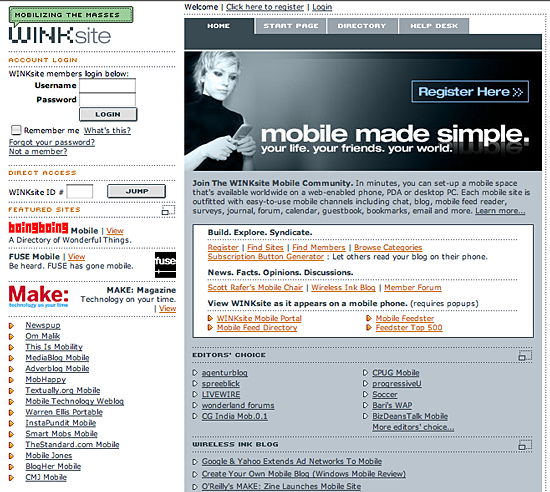
This reminds me of Professor Maeda’s post, comparing the evolution of the Yahoo and Google home pages.
True simplicity is remarkably difficult to achieve. And you don’t get there through taglines.
JJG and Peter and the UX Throwdown at AIGA Boston, September 16, 2005
JJG and I will be appearing Live! on stage! at AIGA’s national conference in Boston, in our two-man show, “Is User Experience Dead?” (4:30-5:30pm, Room 312). (My answer: “yes.” His answer: “no.”) We’re imagining something out of Punch and Judy, or American Gladiators. Whatever it is, walloping will occur!
This also means, by association, that I will be in Boston for the conference. And the AIGA ain’t my normal crowd. So if you’ll be in attendance, and interested in meeting up, lemme know. (Email care of peterme AT peterme DOT com).
Web 2.0 as utopia, and a new weblog
danah’s recent post inspired me to respond. And that response (“Web 2.0 as Utopia“) is not here on peterme.com, but on a new weblog, Designing for the Sandbox.
I realized I wanted to track and comment on Web 2.0 (and related) discussions, and didn’t want to do so in the context of this, my personal site. This is something of an experiment for me, and we’ll see how it goes. If you’re interested in that stuff, I suggest visiting there, as I won’t be posting such stuff here any more.
Laptops – They SO are mobile
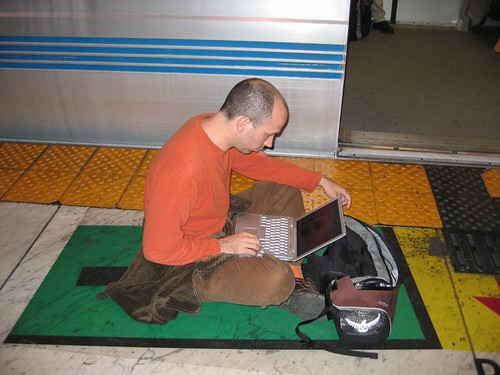
A couple months ago, I wrote a post, “Laptops are mobile devices, too,” where I wondered why product designers haven’t taken advantage of laptops mobility, and treat them essentially as desktops. Most folks agreed, except for Thomas Vanderwal, whose comment made absolutely no sense to me.
Anyway, in a feature story in today’s Chronicle, C.W. Nevius discusses how people are increasingly taking their laptops with them on vacation. Not in order to work while on holiday, but because the laptop can serve so many vacation-oriented uses, particularly personal email and watching videos. (Which is exactly what I did with my laptop when I was in L.A. the last few days.) Googling shows that this article is based on a survey that has been reported for a while now.
Movie Review: Me And You And Everyone We Know
We just saw the film Me and You and Everyone We Know, and it’s the best movie I’ve seen in the last week (which means, better than The 40-Year Old Virgin, which was good, and better than Broken Flowers, which was only okay). MAYAEWK is probably hard to locate right now — it’s been in theaters a few weeks, and is a highly… idiosyncratic indie flick (I’m purposefully avoiding “quirky,” because I don’t think that overused phrase does the film justice). But it’s worth locating, worth seeing if you’re interested in a strong personal voice telling a set of stories in a truly cinematic way.
The movie also goes to show that while Anthony Lane is a good writer, he’s a pretty shabby critic.
All Your Control Are Belong To Us
If you’re interested in this Web 2.0 thing, and you haven’t yet read Abe’s thoughts on it, you should. His distinction of the insiders (those who build the tools) and the outsiders (those who use the tools) is reminiscent of Neal Stephenson’s use of Eloi and Morlocks (click and scroll down a bit) as a way to distinguish between the hackers who build our technological systems, and the people who use them.
And while I find Abe’s views valuable, I feel the need to question two of his many claims. The first is this idea of the early Web as one where “anyone” could build. I simply don’t think that’s true. Because not “anyone” could master HTML, not “anyone” could understand the arcana of registering domain names and pointing them to a server, not “anyone” could figure out how to upload something via FTP. Many people recognized Blogger’s early success as simply putting a friendly interface on FTP. So for however easy those earlier approaches seemed, these publishing tools have made them much much easier — and allowed a far greater audience the ability to contribute.
Later on, Abe references my essay on relinquishing control, and claims,
“In the end he’s not just arguing that companies should relinquish control, rather he’s arguing that they should relinquish control over to him, his company Adaptive Path, and others that share their philosophy. Reliquish control over to the professionals, those that know what they are doing, know how to control things on the internet.” (Emphasis his)
As the author of that essay, I feel confident in saying that Abe’s take, on this point, is balderdash. One of the challenges facing Adaptive Path, and anyone seriously pursuing designing in this space, is that we as designers, we as professionals, we as those who think we know better, we, too, have to relinquish control. And that is exactly what I meant in my essay. If I were to truly believe what Abe claims I meant, I would be hypocritical. I don’t want companies to give control to me. I want them to give control to their customers. Because if there’s one thing I’ve learned, those of us who “know what they are doing” often don’t.
That said, Abe provides some remarkably cogent critiques. He’s right to have called into question my use of Netflix in my original essay, because, clearly, Netflix isn’t relinquishing control, but shifting how control is levied. And I think this suggests a potentially interesting path of investigation — what are appropriate forms of control in this space? What control are people willing to give up, as long as they receive it elsewhere?