Heading to North and South Carolina

From December 18 to the 25th, Stacy and I will be in North and South Carolina. We’re starting and ending in Chapel Hill (well, Carrboro), to visit friends and their new daughter! We’re planning on seeing Charleston, Columbia, and Winston-Salem as well (got to go to Old Salem).

Suggestions for points of interest along this route are welcome. Historic or food-oriented a plus!

Notes from User Interfaces for Physical Spaces

Yesterday I attended User Interfaces for Physical Spaces, a one-day workshop and field trip co-produced by MAYA Design and the IA Institute. The day was essentially an extended case study of the work MAYA did with the Carnegie Library of Pittsburgh (the public library system, CLP), applying methods of user-centered design and information architecture to the design of physical spaces.

The story of how the project landed at MAYA was illuminating. The CLP planned for major architectural renovations to their main library and branches. They sent out an RFP to a number of architecture firms. They awarded the project to EDGE design, because their proposal included their stories of trying to *use* the library (and struggling). EDGE developed a vision for a modern library, including information displays and kiosks. MAYA was originally brought in to help with the interactive portions of the system, but when they asked EDGE and the CLP what went on the kiosks, no one had a good answer. MAYA realized they needed to step back and truly appreciate the space.

In MAYA’s Office

The bulk of the workshop took place in MAYA’s offices, where we walked through the development of their designs.

MAYA’s first project was a 6-week-long intervention, with discussions with key CLP staff, guerrilla on-site research, development of key personas of library users, scenarios of use, and the development of a framework for understanding the entire system of use.

With their scenarios, they identified four components in this process: Users (1) go through Organizers (2) to get Materials/Activities (3) in order to Use/Participate (4).

This is a pretty standard process for smart user-centered design, but there was a key point of differentiation from screen-based work. It comes with what MAYA calls Organizers. MAYA identified three classes of organizers — Library Staff, the Physical Space, and the Categorizations in the catalog system.

MAYA developed scenarios of use for their four key personas, and through that identified breakpoints — moments where a person’s attempt at getting something done is stopped by some problem they run into.

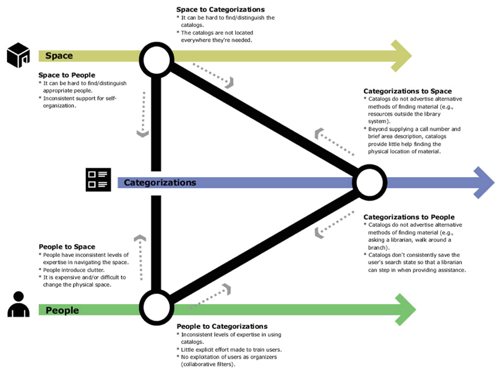
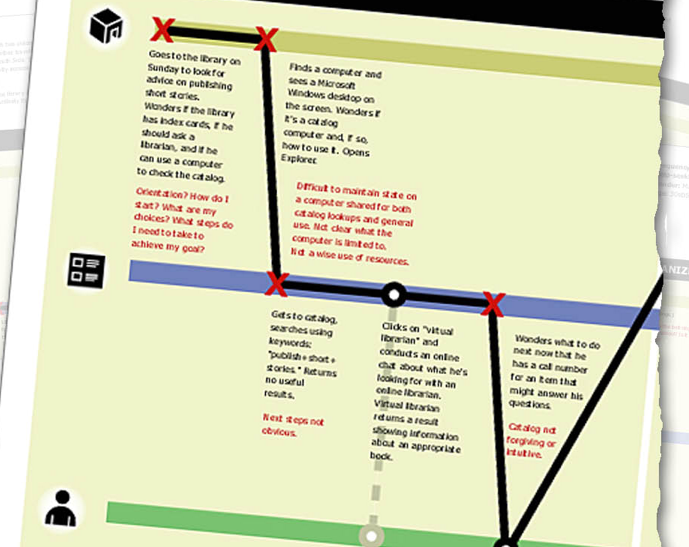
Initial attempts at diagramming the scenarios linearly went nowhere, but thinking through the problem, they realized the breakpoints mapped to the organizers — things broke down when switching from people to categorizations, or from the categorizations to the space.
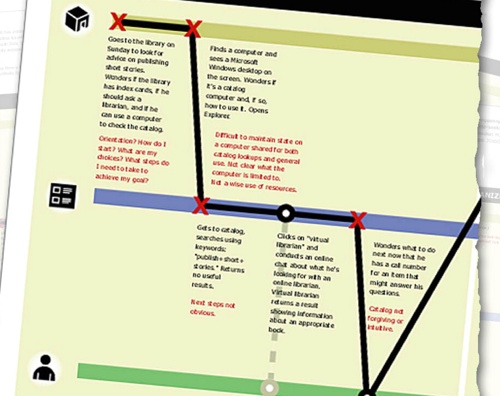
Mayaclp Breakpoints-1
Click to enlarge

The A-ha! moment for them came in this distinguishing these organizers, because it led to the development of a framework that allowed them to get their head around the problem. The realized that the primary problems people had in using the library occurred when people switched from organizer to organizer — from using the online catalog to engaging with the space, or from talking to a librarian to using the catalog.

This also served as an A-ha! For the CLP. Up to this point, MAYA was essentially telling them what they already knew — there was a myriad of problems people face when using the libraries. The framework allowed the CLP to better understand the problem space.

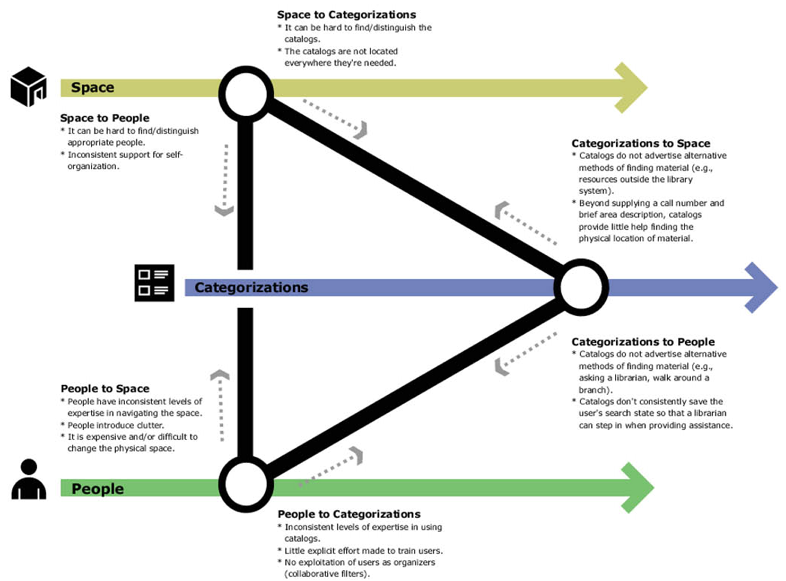
So, unlike screen-based work, where we tend to get caught up in breakpoints with a single “organizer” — the software — MAYA had to grapple with three potential points of failure. This is orders of magnitude more complex.
Mayaclp Triangle
Click to make bigger

This triangle shows what needs to be considered when handing off from organizer to organizer before the breakpoints occur — and to smooth those handoffs by being aware of the issues that arise when making those leaps.

The 6 week project ended with “Tiger Teams” of 4 or 5 folks — designers and CLP staff — rapidly prototyping solutions to accommodate this new understanding. These blue sky propositions were meant to encapsulate the research in an explicit fashion — not just giving the CLP a bunch of documents with models on them, but ideas for the implications of these findings on design.

After the 6 week project ended, the CLP asked MAYA to help develop an actual solution for the library. This involved, essentially, in developing an information architecture that tied together the three organizers. They overlaid this information architecture on the physical architecture, by annotating actual building blueprints. They spent a lot of time refining nomenclature for wayfinding (thus arriving at “Ask A Librarian” instead of “Reference Desk” or “Customer Services” instead of “Circulation Desk”), and they worked closely with Landesberg Design to develop a signage system that communicated this information architecture clearly.

Field Trip!

After walking through MAYA’s process, we then boarded a chartered school bus (really! yellow on the outside! green canvas seats!), and headed to some renovated libraries. The first library was the Squirrel Hill branch.

This library demonstrated just how well the system worked. Clear, simple signage illuminated what you could do. Signposts guided you as to where to go. What was amazing was how well it all just worked — if we hadn’t spent the last 6 hours being prepped for this experience, I don’t know how many of us would have realized what had gone into the design of this space, because it just felt right.
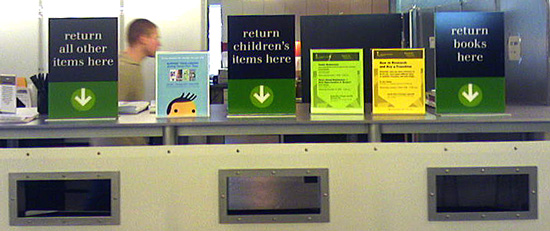
Mayaclp Signs

Squirrel Hill residents, though, know just how difficult the old library was, and dearly love their new space. It’s clearly become a true community center — people hanging out, reading, surfing the internet (free wi-fi!), and connecting with one another.
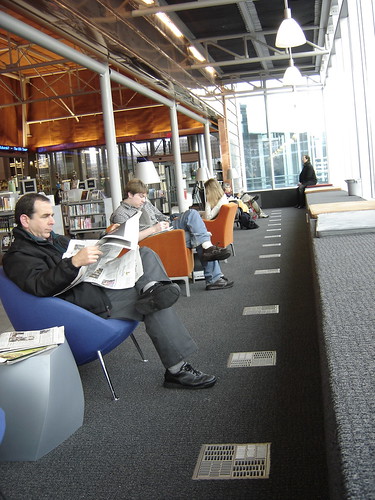

Photo by James Melzer

The second library we visited was the Main Library. This library has a host of complications, the biggest of which is that it’s in an 1895 building on the register of historic places. This meant that it’s boxy, room-to-room-to-room layout couldn’t be changed.

Still, the Main library had some important successes. The Cafe is extremely popular, and its yellow floor has become a point of reference for wayfinding.

They’ve also been able to incorporate much of the signage and language that worked so well in Squirrel Hill.

The Main Library also demonstrates what happens when there is too much architect-intervention. Each library is modified by a different architect. At Squirrel Hill, the architect was content to pretty much follow the plan, and create an inviting, open space that just worked. At the Main, the architect did very well to open up and brighten the space, but often missed the point when it came to wayfinding.
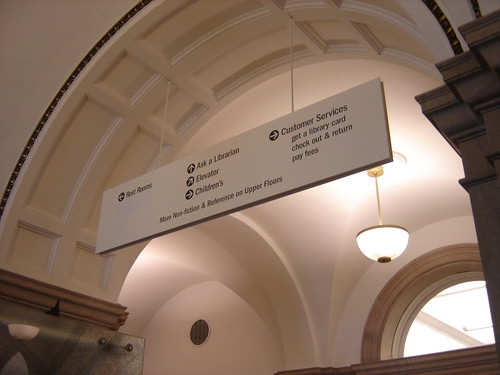
Whereas the wayfinding system designed for the libraries involved white type on black, at the Main, they used the more traditional black type on white. Unfortunately, white is everywhere (all walls were wisely painted white to improve the lighting), and that means the signs get lost in the sea of white.

Also, the architects seemed to have a fetish for glass panels. Glass walls are everywhere in the new library, whether it makes sense or not. Perhaps the most egregious case is above the librarian desk near the entrance. While you can see the “ask a librarian” sign if you’re staring at it straight on:

…when you shift your angle, it pretty much disappears:

It’s fascinating to me the way that designers simply won’t leave well enough alone. Actually, well make well enough worse by fiddling with it.

Well, this was a great event, and a huge thanks to MAYA for opening their doors, and the work, up to others.
Urban walking – musin’ on cruisin’

The chapters I’m reading in Wanderlust dwell on urban walking. Solnit points out that, in the early 1800s, walking around cities was quite the daring affair.

Perhaps, not surprisingly, it brought to mind some of the seamier experiences I’ve had on foot. This is probably true for every peripatetic male — at some point, you will be cruised.

End of the Innocence

The first time it happened, I was 12 or 13. I was hanging out at the Santa Monica Pier, playing video games. I had with me a copy of Hitchhiker’s Guide to the Galaxy, which I planned to read as I walked the mile-and-a-half home.

As I walked up the ramp that connects the pier with the city of Santa Monica, I was joined by a skinny mustachioed guy, probably in his late 20s or early 30s. I remember seeing him down in the arcade, where I didn’t think anything of it. Being somewhat oblivious (well, and 12 or 13), I didn’t think much of it as he struck up a conversation with me.

It didn’t occur to me to do anything other than converse with him. So, as we’re heading down Ocean Ave., we’re talking about lord knows what, when he invites me to his trailer to play video games. He had an Atari or Colecovision or something (this would have been 1985 or sp), and his trailer or whatever he lived in was parked in the lot next to the RAND corporation.

Well, it was at this point that I realized what was going on. I didn’t make a scene out of it — in fact, the conversation kept me from boredom. I rebuffed his offer, though he was dogged in sweetening the deal (and if memory serves, that might have been literal — he might have talked about candy he had).

After about a mile, as I was turning down 3rd Street to head home, this guy realized he wasn’t getting anywhere, and peeled off. I read my book the rest of the way home, and told my parents what happened. They were, more than anything, bemused.

Beantown Buggery

A more recent incident happened a couple years ago in Boston. I had been hanging out near downtown, and as dusk turned to dark, I decided to walk back to my hotel in Cambridge. There’s a park along the Charles River that leads to a bridge.

Walking in the park, a man on a bicycle heads toward me. I must have made eye contact, because he promptly stopped, turned around, got off his bike, and walked with me. Unlike my youthful experience, this was far more… direct and ribald. I don’t remember exactly how the conversation unfolded, but in short order he claimed a 9-inch penis and that he was quite good with otherwise straight men.

I professed my disinterest from the word Go, but he was persistent, striding alongside me for, I don’t know, half a mile or so. Finally he realized he was wasting effort, got on his bike, and departed.

As I crossed the bridge, I called Stacy (back in the Bay Area) to tell her what happened. “Guess what, honey! I was cruised by a guy with a 9 inch dick!” She wanted to know if I had actually seen proof, and I had to admit that I hadn’t. You mean, that guy might have been lying?

Technorati Tags: ,

Whither Warriors?

This is the year I decided to really try to follow basketball. It’s been made easier by having a local team that doesn’t suck wind — the Golden State Warriors. Lead by point guard Baron Davis, they can prove to be a formidable opponent, especially when J-Rich has got his hot hands.

The Warriors were disappointing in their last two games, though, losing to the Suns and the Pistons. Yes, both of those are better teams. But both times, the Warriors kept it a game until well into the fourth quarter, when they simply fell apart.

This is probably the most frustrating thing about being a Warriors fan. They’ve clearly got lots of talent, drive, and enthusiasm. When they’re on a roll, you can get some Laker-like Showtime with Davis at the helm. But they have a tendency to play sloppy ball, chucking up needless threes, not coordinating, not making plays.

One good thing about being a Warriors fan this year: because they are winning, and the local football teams suck major major wind, they’re actually getting decent press coverage.

It looks like the Warriors will make it into the playoffs this year… Let’s hope they get past the first round.

Fun fact: before playing in Oakland (and being called the “Golden State” Warriors), the team was the San Francisco Warriors, and on their uniforms was this logo:

Separately, and probably obviously, the Spurs are still my favorite team. Though I wish I could have seen their collapse to the pitiful Hawks. The Spurs are an interesting team in that they rarely fail, but when they do, they have a tendency to fail Big.

And, um, how ’bout them Clips?

peterme’s top bookstores

As someone who lives very much in his head, for me, visiting a good bookstore is like wandering a city. I get lost. I lose all track of time. I forget to eat. It’s not about “getting lost in a book,” or some other romantic notion of literature. I tend towards the non-fiction aisles, where I can engage with a world of ideas – political, scientific, social, cultural, experiential, historic.

Inspired by this article in the Guardian, I thought I’d catalog my favorite bookstores. I’m not nearly as worldly as Mr Mercer, but there are a number of places I find myself returning to as I travel (whether in other cities, or just around the Bay Area).

Green Apple Books
San Francisco, Clement St. just off of 6th Avenue.
Quite possibly my favorite bookstore. Green Apple is a remarkable place for getting lost. I can spend hours roaming the Winchester-Mystery-House-Like aisles, skimming spines, loading myself down with tomes. They also have the best “New Arrivals” shelf of any used book store in San Francisco, often with review copies of new books at way-below cover price.

Powell’s City of Books
Portland.
Portland’s number one tourist destination, and with good reason. You can take a whole day here, and not wander every aisle. Particularly important in the Powell’s-verse are the specialty bookstores offsite — the science and technology bookstore not far from the main site, and the home and garden store on Hawthorn clear across town.

Moe’s Books
Telegraph Ave, Berkeley
I came to love Moe’s as an undergrad at Cal. As a resident of Berkeley, Moe’s provides a reason for trekking to the otherwise undesirable strip known as Telegraph Ave. Four floors of books, I immediately head to the third — physics, engineering, sociology, film, comix, cognitive science. Thanks to the proximity to Cal, you can find smarty-pants used books here that are difficult to come by otherwise.

Quimby’s Bookstore
Chicago.
My one must-visit destination whenever I return to Chicago. Quimby’s is a shrine to alternative media — zines, indie comix, small press books.

Housing Works Used Books Cafe
Crosby Street, New York, NY.
A welcome respite in the hugger-mugger of Manhattan. Though the selection is small, it’s of good quality, so you’re likely to find something worth getting. A cafe in the back encourages lingering, and all proceeds go to an excellent cause.

St Marks Book Shop
Just off Astor Place, New York, NY.
Mmmmm, edgy. Lodged between NYU and the East Village, the St Marks Book Shop bursts with intellectual tomes, with heavy representation from post-modernism, critical theory, Frenchies, and the like. Its thriving existence surrounded by mega-chain book stores proves that Barnes and Noble’s doesn’t put bookstores out of business — it just puts bad bookstores out of business.

Gotham Book Mart
46th Ave, New York, NY.
The most literary of literary bookstores. Also, home to all things Edward Gorey.

MIT Press Book Store
Kendall Square, Cambridge, MA.
The MIT Press publishes a lot of great stuff, and this book store has it all, along with selections from other publishers as well. Always worth a trip to the “hurt books” shelf, where you can get new titles at remarkable discounts.

Other Bookstores I Like, Just Not As Much As Those Above

Hennessey and Ingalls, Third Street Promenade, Santa Monica
William Stout Books, Montgomery Street, San Francisco
Dog Ear Books, Valencia Street, San Francisco

City I’m Surprised Doesn’t Have A Great Bookstore

Minneapolis. Unless I haven’t found it yet. I’ve seen the stores near the U, and there’s that one in Uptown, but really, for such a culturally vibrant city, it’s surprising that there’s no bookstore mecca. Or maybe I just haven’t found it? Or it’s over in St. Paul?

Please Don’t Mention This Bookstore in the Comments

The Strand, in New York City. I hate the Strand and it’s 8 miles of books. I do not go shopping in order to be endlessly bumped and jostled, nor to sift through piles and piles of crap to get at anything good.

Joe Lieberman, Still an Odious Fundamentalist Toad

A couple years ago, I got some flack for labeling Senator Joseph Lieberman, a “Democrat” from Connecticut, as an odious fundamentalist toad. Well, as this NY Times article reports, Sen. Lieberman continues to justify my claim. The article discusses Lieberman’s support for Our Dear President, with his comment “We undermine the president’s credibility at our nation’s peril.”

And I suspect Lieberman is such a toad because of his fundamentalist religious views, running seemingly as deep as Bush’s, or Blair’s. Fundamentalism, *of any stripe*, is dangerous. Sadly, Connecticutans seem to like him, so we’ll have to continue to put up with his presence on the national stage.

TiVo – Pioneer with a bullet in its back?

Matt has posted an excellent interview he conducted with Michael Cronan, famed designer, and primary force behind TiVo brand identity. Much of the discussion revolves around the name “TiVo,” and the perfectness, the inevitability of that name.

And I thought — could a name be too perfect? Is TiVo *so natural* a word for what the service does, that it is too easy to not think of as a specific brand or product, and just moves immediately into genericism (like Kleenex?)? Is it important, when naming companies, to not come up with too good a name? Especially for a first-mover company that’s providing a service that never existed before? Because if that name goes generic, it’s easy to neglect the company that made it.

Gay cowboys – old hat!

So, with the release of BROKEBACK MOUNTAIN comes an awareness of gay cowboys. I grappled with gay cowboys about 10 years ago, when I worked at the Voyager Company. We released a CD-ROM called “Who Built America?” essentially a history textbook come alive with audio, video, photos, diaries, and the like.

“Who Built America?” was bundled with Apple computers sold to schools, and with good reason — it showed off the multimedia capabilities of the machines. However, what some schools realized, and what some parents’ groups didn’t like, was that the CD-ROM also dealt honestly with American history — including illegal abortions and, as the disc called it, “male-to-male intimacy in the west.” And these stories are coming from the turn of the century, not the mid-60s.

The ensuing controversy lead to Apple dropping the disc, which lead to a shitstorm on Usenet — in large part spurred by me (I was pretty much the only Usenet savvy employee at the time.)

It even made the Wall Street Journal.

My favorite Voyager t-shirt is the one we printed up in the face of this controversy, as we were headed to the American Booksellers Association conference that year. It was a screenshot from the CD-ROM, showing the “male-to-male intimacy in the west” entry.

Because of my own naivete, it surprised me that others were surprised by this. I mean, yeah, cowboys are the picture of American manliness, but, come on — men, alone on the frontier, wearing chaps!

Anyway, the CD-ROM is still worth owning, and you can buy it online. I can’t speak to the quality of the second CD-ROM (1914-1946), but it’s probably worth a shot.

Google and their knowledge workers

So, I finally got around to ready, “Google: Ten Golden Rules,” about how that company hires and manages their employees, and I came away from it unimpressed, and, even, feeling a little icky.

Their rules basically made sense to me (Hire By Committee, Pack Them In, Make Coordination Easy, etc. etc) with the one exception of “Strive to reach consensus.” I mean, I guess it’s an okay thing to strive for, but trying too hard to reach consensus gets in the way of progress.

Anyway, that’s not what bugged me. What bugged me was the tone of the article, written by a CEO, and Berkeley professor. It has a remarkable Us and Them sentiment. At the beginning of the article, they reduce their entire workforce to the class of “knowledge workers,” and then, for much of the article, Google employees are referred to as “them” and “their.” It struck me as a remarkably distant approach, as if Eric and Hal were talking about how they care and feed the ants in their ant farm.

Another, and possibly related thought, is why are so many afraid of Google when they’ve demonstrated competence in only three areas (search, maps, and webmail)?

Random acts

The dog attack that I just wrote about is the second significant random act to happen to me in the last 6 months, along with the car accident.

What both incidents made clear is, well, the role that happenstance plays in our lives, and how all your plans can so easily get shot to hell in a heartbeat. In both instances, I was on my way to do other things, and had planned out, well, at least the rest of the day. And in both instances, everything pretty much had to stop and that specific thing needed attending to.

It reminds me of that remarkable story-within-a-story in The Maltese Falcon, of the man Flitcraft who nearly dies from a fallen beam, and is spurred to start a new life (which ends up looking just like his old life). It’s a brilliant and bizarre detour in the novel, a long passage in an otherwise highly efficient narrative that serves almost as a primer on existentialism.

Anyway, such dramatic incidents always bring the immediate, the present, to snap into focus. It demonstrates just how tenuous all our plans really are.