MX 2008 – Managing Experience Conference Shaping Up to be the Best One Yet

Adaptive Path’s MX San Francisco 2008 is shaping up to be a major event for managers, directors, and VPs of user experience design. Taking place April 20-22, the program is devoted to defining the emerging discipline of creative leadership, and we’ve already lined up an amazing set of presenters, with more to come.

The contributor that probably most excites me is Chip Conley, CEO of Joie de Vivre Hospitality, a chain of boutique hotels in California. I blogged about Chip a couple years ago because I was so impressed with an interview he’d had with the SF Chronicle. Chip is not only a great experience designer — his hotels are some of the most fun and funky around — but he’s a thoughtful manager who recognizes that the key element to a great experience is happy happy employees.

And hey, why settle with only one Chip? We’ll also have Chip Heath, co-author (with his brother Dan) of Made To Stick, an excellent text on what it takes to craft and present ideas that resonate with their intended audience. Communication of concepts is a big challenge for experience designers (we can get caught up in our own abstractions). I first heard Chip in this interview with Moira Gunn, and am thrilled his joining us.

We’ve also got Peter Coughlan from IDEO, Cordell Ratzlaff (formerly Frog and Apple, now at Cisco), Ryan Armbruster (formerly Mayo Clinic, not at a healthcare startup), Secil Watson (VP of customer experience at Wells Fargo), with more speakers to be announced.

As with prior MX events, MX San Francisco is devoted to figuring out what it takes not just to create great experiences, but get them out in the world for people to enjoy. Those past MXs have been some of the best events we’ve put on at Adaptive Path, and I have little doubt that this one will surpass it. (And I haven’t even mentioned the venue, the delightful Mark Hopkins hotel on Nob Hill. This means we’re taking advantage of the Top of the Mark, perhaps San Francisco’s premier penthouse bar, and the Tonga Room, a famed tiki hideout in the Fairmont across the street, for evening fun!)

The current registration price is $1295 (through February 3). If you register with promotional code FOPM (friend of Peter Merholz, as you all are!), you’ll get 15% off that price.

The economy – is it *really* that bad?

Something I’ve been having to wonder about is the economy. The news is filled with talks of impending recessions, and discussions that it’s too late to do much about it.

However, my business, Adaptive Path, and all similar businesses of which I’m aware, are overwhelmed by work opportunities. We’re all turning down leads left and right (and, believe me, we’re grateful for the situation we’re finding ourselves in).

The thing that confuses me is that consultancies such as Adaptive Path tend to be the first hit by any economic downturns — when companies feel the pinch, external spending is often one of the first things to go. Creative services firms of all types were hammered by the last bust, and definitely started feeling it before the rest of the economy. But we seem to be weathering this uncertainty remarkably well.

What’s going on here?

The Info-Slit Will Not Die

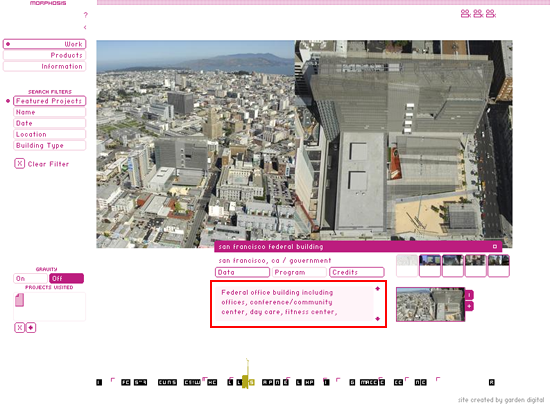
Way back in 1997 or so, web designers explored the possibilities that frames gave for cutting up portions of the screen. One of the unfortunate results of these explorations was the info-slit, a little window for scrolling text, usually four lines high. Info-slits are a pain in the ass to use, as they often deliver a full page of content four lines at a time.

Well, it’s now 2008, and people who should know better continue to use the info-slit. The culprit this time is Flash, and designers who want everything to fit on a single screen. Perhaps the most shameful example I’ve seen of late comes from Organic, an interactive marketing agency that really really should know better (info-slit highlighted in red rectangle):

Organic Slit

And architecture firms are notorious disasters when it comes to web presences, and Morphosis is no exception:

Morphosis Slit

Dear designers: STOP TRYING TO CONTROL EVERY DAMN THING. It just don’t work on the Web.

Memery

I’ve had a meme stuck in my head since pretty much the first time I heard it (or was it read it?). Michael Pollan sums up his latest book, In Defense of Food, with these 7 words: “Eat food. Not too much. Mostly plants.”

As that phrase lodged itself into my brain, I’ve been in awe of the power of it as a crafted meme. I mean, it has actually had an effect on what I’m eating, particularly at lunch time. Shit, I willingly had a tofu dish for lunch today, and I’m pretty certain that phrase played a part. I may be suggestible, but I also think Pollan has done an excellent job crafting a statement that is simple, precise, and meaningful.

Hertzberg on Mormonism

Now, it’s no secret I’m not a fan of any religion (born and raised atheist, and somewhat dogmatic about it.) Given Mitt Romney’s candidacy, Mormonism has come under greater scrutiny. Now, Mormonism doesn’t strike me as any more or less wacko as any other religion, except for one thing… it’s recency. Older religions have the mists of time to help relegate their stories into myths, and, often parables. Mormonism is a modern faith whose foundations are just too easy to call into question. Here’s what Hendrik Hertzberg wrote about the faith in the latest New Yorker:

And the dogmas of Mitt Romney’s sect are breathtaking. They include these: that in 1827 a young man named Joseph Smith dug up a set of golden plates covered with indecipherable writing; that, with the help of a pair of magic spectacles, he “translated” the plates from an otherwise unknown language (Reformed Egyptian) into an Olde English that reads like an unfunny parody of the King James Bible; that the Garden of Eden is in Missouri; that American Indians descend from Hebrew immigrants; that Jesus reappeared in pre-Columbian America and converted so many people that the result was a series of archeologically unconfirmable wars in which millions died; that while polygamy had divine approval for most of the nineteenth century, God changed his mind in 1890, just in time for Utah to be allowed into the Union; and that God waited until 1978 to reveal that it was O.K. for blacks to be fully paid-up members of the Church of Jesus Christ of Latter-Day Saints.

The South Park cartoon with the Mormon family that moved to town said many similar things, though funnier.

Comics that move

This morning I read the AV Club’s interview with comics artist Daniel Clowes (perhaps my favorite comics artist of all time, see this Google link for prior mentions.) He states, about comics: “But it’s not an operatic medium. I hear other people talk about being moved to tears by comics. I can’t imagine that.”

And had I read the interview yesterday morning, I would have agreed. Peculiarly enough, though, I cried (well, maybe weeped) myself to sleep last night finishing the graphic novel Laika, about the cosmonaut pooch that became the first mammal to orbit the planet. At times heartbreaking and other times uplifting, it’s remarkably well-told, with deceptive simplicity masking complex emotions. As you read toward the inexorable end, you can’t help but feel for the poor pooch, particularly the unfortunate circumstances surrounding her voyage (rushed to launch for the sake of propaganda, interfering with any scientific benefit).

One of the better reviews of the book I found makes a connection that I also felt, with the film My Life As A Dog, which was my favorite movie for quite a while. In it, the protagonist thinks of Laika as he considers his own situation (sent to live with relatives because his mom is deathly ill).

In 2007 my comics consumption pretty much receded to Hellboy and B.P.R.D.. Trips to the comics store were disheartening, because indie comics (or, at least, non-superhero comics) have become dominated by nihilism of three stripes: guns-and-blood detective stories; dystopic science fiction; zombies zombies zombies. Everything is dark, gruesome (literally), and meant to appeal to masculine ids in their late teens and early 20s. I suppose it’s the evolution for those who grew up with superhero fare, but I find that when I’m staring at the covers of these things at the local comics shop, I just feel sad for all the pathetic men for whom this crap stokes their fantasies. I’m all for juvenilia (did I mention I enjoy Hellboy and B.P.R.D., which are, when they’re at their best, adventure stories of the simplest kind?), but this morose fuck-the-world shit is just so…. lame.

The one bright spot at the end of 2007 was The Umbrella Academy, which captures the whimsy and humor I admire in Mignola-era Hellboy, but definitely with a distinctive personality all its own.

DVD Review: Tilt: The Battle to Save Pinball

Speaking of product design, today’s convalescence (bad head cold) meant I could gorge on the DVD for the documentary Tilt and it’s copious extras.

The movie focuses on the development of Pinball 2000, an attempt by Williams to salvage a dwindling market for its pinball games. I found out about the film through Khoi’s post from last July (definitely worth reading), and, as one who plays the silver ball, thought it was worth a shot.

The movie itself is quite short, barely over an hour in length. It probably serves best as a Harvard Business Review-like case study in product design, development, marketing, and strategy. What’s most interesting is how Pinball 2000 accomplished nearly everything it set out to do (and in a remarkably short period of time), and Williams killed its pinball business anyway. In an interview (MP3) with the filmmaker Greg Maletic, radio host Faith Salie introduced the film by saying, “You’ve probably heard the saying, “Innovate, or die.” But what happens if you innovate and die?”

As Khoi points out, there are plenty of tasty bits for those of us interested in experience design. Most of that is in the trove of extra material provided, including in-depth discussions of the process of designing a pinball game, the different styles that different designers have, and how these designers were very much aware of not just the playability (which was paramount), but feasbility from a cost, engineering, and maintenance perspective.

Unfortunately, I can’t recommend this film to those who aren’t interested in pinball. From a filmmaking standpoint Maletic had two big strikes against him — focus on a niche product (pinball companies were happy to build 5,000 of a product), and a story that, at the time of release, was 6 years old. Maletic never makes it clear why this is an important story that overcomes its nicheness and its age, so it’s really only interesting to pinball devotees. But, as he explains in the commentary, he tried very hard to make a movie that appealed to a non-pinball audience, and so he watered down some of the interesting discussion of design and technology, forcing interested parties to scour the extras to get all the meat off the bone.

My Negative Nelly-ism notwithstanding, Maletic is to be congratulated on producing a quality doc on what must have been a shoestring budget, and pretty much all on his own (he even rendered the animations in the film). It turns out he’s an active blogger with a passion for entertainments of all sorts — amusement parks, pinball, movies. He’s currently working at Bunchball. (What the hell is with the Bunchball website? When Bunchball first launched, it seemed to be about social games. Now it’s about “engagement,” “web catalytics” and “making your site sticky,” all kinds of hideous marketing-ese that obscures just what on earth they are about. Oop. There’s the Negative Nelly again.)

Locating value in interaction design consultancies

One of the trickiest challenges I have is defining what kind of services firm Adaptive Path is. For the sake of this post, let’s say AP is a firm that designs for interactive media — websites, software, mobile phones, devices, and kiosks.

Design for interactive media is a hot space right now, because of all the money flooding in online advertising. For example, Schematic was acquired last September by WPP, a massive holding company of communications services firms. Unsubstantiated word is that Schematic went for 6 times earnings, which is astounding, considering services firms typically get at best 3x. (12 years ago, I worked with Schematic CEO Trevor Kaufman when he lead up the website at Voyager. What a long strange trip!)

The thing is, AP is not an interactive design firm like Schematic, Organic, Razorfish, Digitas, etc. For one thing, we’re much smaller (though we feel big to ourselves, at 32 employees, we’re about a fifth to a tenth of the size of these others firms). But, and this is the crux of this post, we pretty much don’t touch marketing, and never advertising.

(In 2005, we decided to never do “just marketing” work again. This is because, although lucrative, as attested to by the growth of these other agencies, we realized that the people we brought on pretty much loathed marketing communications. We don’t want to work on the stuff that talks about the thing — we want to work on the thing itself.)

See, all these other companies are essentially interactive agencies, with a heavy emphasis on advertising and media planning. And currently, because of the movement of advertising dollars online, these companies are doing remarkably well.

Adaptive Path is more like an interaction design analog of an IDEO or Frog — where they began with industrial design, we began with interaction design, and we’ve all evolved into product strategy and design firms. In 2007, we found ourselves going up against IDEO and Frog far more than interactive agencies.

Now, back to the title of this post. I suspect that “the market” finds it a lot easier to find value in interactive marketing agencies more than in interactive product consultancies. And what I’m trying to figure out is why this is the case. Products (and I’m using that term generically, to include services and all manner of offerings) are what provides value. They are what get people to spend money, to engage in a service. They *create* value. But it’s marketing design, particularly advertising, which is what has been lucrative — think of the big ad firms going back 40, 50, 60 years. There are no big product design firms more than 30 years old, and there still isn’t anywhere near the kind of money in product design as in marketing.

(As I write this, I realize that the rise of the product design firm over the last 30 years, and the two companies I most associate with that rise (IDEO and Frog) are pretty much the result of the increasing complexity of product design thanks to computerization.)

I don’t have a close to this thought. I’ve just been mulling over why product design firms, which create value, don’t seem to be perceived as valuable as marketing design firms.

A Book Only San Francisco History Dorks Should Read

I also just finished Wings of Cherubs, a book that uncovers the history of Pisco Punch, a San Francisco cocktail famous at the turn of the last century. I’d stumbled across Pisco Punch in an article from an old California Historical Quarterly titled “The Secrets of Pisco Punch Revealed” (reprinted here). I then traveled to Chile and Peru and had many Pisco Sours, and have been smitten with the history of the concoction.

Wings is the strangest book I’ve read in a long time. The author has done some amazing research on the history of pisco and Pisco Punch in San Francisco, and a little bit about early bar scenes. Instead of presenting this in a straightforward fashion, he adopts the mode of a quasi-historical novel. I say “quasi” because he uses tales of his present-day research (poring through archives in the San Francisco Public Library, visiting the sites where the history happened) as mechanisms for transporting him to the past, meeting the various personages important to the story. Also, it’s clear that English is not the author’s first language, and that no copy editor was employed — sentences run on, the structure is clunky, and at times you’re unclear of what, exactly, is happening.

All that said, I eagerly recommend this book to SF history nerds. The poor diction is more than made up for by the passion, enthusiasm, and vigor with with the story is told, so the reader is swept along by the historical discoveries. It’s also one of the few histories of this period of SF that neglects the earthquake, which is fine by me. I also appreciated the insight into San Francisco’s early connections with Peru, which was an important port on the trip around South America to and from SF.

It’s a shame no bars in San Francisco make Pisco Punch any longer. A true San Francisco original, it speaks fundamentally to the development of the city in the world.