I’m heading south on Sunday the 28th, and will be there until the morning of Thursday the 1st. Should we hang out? Email me: peterme at peterme dot com.
User Experience Week Wiki
Adaptive Path is experimenting with having a public wiki during our User Experience Week conference. (Courtesy of our pals at Socialtext.)
On the wiki, you can read notes from each of the sessions (say, Ajax, a case study on Wells Fargo’s content efforts, and field research), find attendee’s weblogs, learn about jobs in the DC area, birds of a feather discussions on intranets and cultural change, and photos from Flickr.
It’s worked out… pretty good. Not great (it’s not clear *when* you should use the wiki, not everyone has a laptop, etc. etc.), but I think for those who have used it, it’s been pretty beneficial.
Off To Our Nation’s Capital
Tomorrow morning I head to the land of the security lockdown, where we’re hosting our User Experience Week.
On Tuesday, August 23rd, we’re hosting beers at Fado, 808 7th Street NW, from 5:30 until we cannot stand no more. Please join us!
Kottke says what we’ve all been thinking
Here. Though, if you don’t care anything about the internet industry, it won’t mean anything to you.
Yahoo! – Walled Garden or Commons?
This week’s Economist features a story on Yahoo!’s Personality Crisis. (scroll down a very little bit — it’s a cut and paste into someone’s blog.)
It very much touches on the philosophical issues of Web 2.0 bandied about of late. The story’s main thesis being that while Yahoo! attempts to match Google in terms of openness (acquisition of Flickr, etc.), such openness is in direct conflict with its business model — which is one of a media company that seeks to be “The only place anyone needs to go to find anything, communicate with anyone, or buy anything.”
I’ve argued before that Yahoo is not a sandbox company. I was refuted with calls of, “But what about these APIs? What about Flickr?” And in response to the Economist’s article, folks like Jeremy Zawodny plead, “Look at what we did with My Yahoo!. Check Yahoo! News. Not to mention the bazillions of RSS feeds we’ve been pumping out: News, Search, Flickr, Finance, Groups, 360, My Web, and more. Yahoo! is probably one of the biggest f’ing aggregators of third party content in the world.”
But that’s exactly the Economist’s point. There’s no personality crisis if Yahoo *isn’t* attempting openness. But these refutations strike me as small potatoes in the megalith that is Yahoo! And endeavors such as bulking up Yahoo’s presence in southern California strikes at the very heart of this conflict. Hollywood is not known for its open philosophy when it comes to content.
Clearly, it will take time before Yahoo figures itself out. But in the meantime, I encourage people at Yahoo to take the Economist’s article seriously. If you can’t recognize this inherent internal tugging, then you’re simply fooling yourselves.
The New Drink

I believe it was Erika Hall who first said that, “what cosmopolitans were to the dot boom, mojitos are to Web 2.0.”
No. Really. It’s not *about* the technology.
[[Hello, Scobleizers! If you like this post, you might want to read:
Web 2.0 – It’s not about the technology
Designing for the Sandbox – slides from my presentation
Designing for the Sandbox – the original post
How I Learned to Stop Worrying and Relinquish Control]]
Rashmi challenges my philosophical bent with her writeup of the web 2.0 panel:
In my opinion, the logic (philosophy if you will) of Web 2.0 reflects its technological underpinnings. A good example is the open source movement. Now, we even have open source beer. But initially, to understand the philosophy of open-source you had to understand developer speak. As Stewart Butterfield noted at the panel, Flickr wanted rich interactivity (refreshing parts of the page at a time) so they had API hooks – they kind of went with it, rather than fighting it. The API’s facilitated the openness. Currently, the logic behind Web 2.0 is baked into API’s, RSS etc. Also, I question whether any business will move to this approach because it is a compelling philosophy. They will shift because it is an attractive business proposition, or because technically it makes sense/is unavoidable, or a mix of both.)
But I think this is exactly backwards. Open source didn’t require developer speak. As Eric Raymond showed, he had to get *developers* to understand open source by using metaphors of cathedrals and bazaars. The conceptual underpinnings are not predicated on the technology.
APIs facilitate openness, but they’re meaningless if your organization doesn’t have the conceptual underpinnings to take advantage of it. And while the “logic” of Web 2.0 might be baked into APIs, RSS, etc. (and I’m not so sure about that), the approach is not.
If business shifts to this approach *without* appreciating the compelling philosophy, well, they’ll fuck it up. They’ll fuck it up the way that Barnes and Noble did when they simply tried to copy Amazon’s features. The point isn’t the features, it’s the underlying philosophy of relinquishing control. Since Barnes and Noble as a company didn’t appreciate the philosophy, they invested a lot of time and energy into features that then languished. Same thing with Blockbuster. They tried to copy Netflix’ policy of No Late Fees — but because they don’t have the philosophical underpinnings in place, they fucked it up, and now have to post big “End of Late Fees Terms” links on their home page, because customers were getting confused when, after having a DVD for a week, they found out they were then charged the COST of that DVD.
As Ross made clear, simply adopting Web 2.0 technologies does not make you a Web 2.0 enterprise.
In fact, I’m a little distressed that the program chair for BayCHI (the “H” stands for “Human”!) would express such… technological determinism about this. As Paul Rademacher said on the panel — these technologies have been around for at least 5 years… They’re being adopted *because* the philosophy is starting to spread…
You forgot “limp-wristed”
William Rohrbach wrote the following to Adaptive Path’s general contact address. The “Q” and “A” part is a quote from the added material to Jesse’s Ajax essay.
“Q. Did Adaptive Path invent Ajax? Did Google? Did Adaptive Path help build Google’s Ajax applications?
A. Neither Adaptive Path nor Google invented Ajax. Google’s recent products are simply the highest-profile examples of Ajax applications. Adaptive Path was not involved in the development of Google’s Ajax applications, but we have been doing Ajax work for some of our other clients.”
Ahhh… maybe you should mention where Ajax had its genesis…specifically Microsoft. Or as assholes like you call them M$.
And the highest-profile example of Ajax and still the best is Outlook Web client.
Fucking open-source pansy loving shit fuck pricks.
That last line is become our new motto.
A Book that Changed My Life: The Design of the Everyday Things
A month or so back, I attended a book reading put together by Kevin Smokler for his edited work, Bookmark Now: Writing in Unreaderly Times. At the end of the event, he asks the audience to tell him about a book that changed your life.
 I thought for a moment, but not much more than a moment. Don Norman’s The Design of Everyday Things emerged in my head as the obvious choice.
The year was 1994. I was one year out of getting my B.A. in anthropology at Cal. In June, I moved from San Francisco to New York to intern at The Voyager Company, a multimedia CD-ROM publisher. Voyager was expanding pretty rapidly. “Multimedia” was to 1994-95 what “.com” would be to 1998-99.
I was brought in to work on a series of CD-ROMs called Our Secret Century, a curated selection of films from the Prelinger Archives (much of which can be viewed at The Internet Archive). However, shortly after I began, that project was shelved.
There were CD-ROMs in production needing to get out the door, and so I was put on Quality Assurance duty. The first title I worked on was “First Person: Donald Norman – Defending Human Attributes in the Age of the Machine.” I had never heard of Don before. The CD-ROM consisted of the full text of his three books up to that point (The Design of the Everyday Things, Turn Signals are the Facial Expressions of Automobiles, and Things That Make Us Smart, all listed here), annotated with animations and videos of Don that further explained the concepts in the books. My job was to go, page by page, and click around, and make sure everything worked.
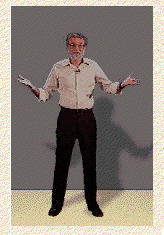 This is an odd way to read a book, but it also meant that I engaged with the text to a level of depth I probably wouldn’t otherwise. And, as has happened with so many other people, when he criticizes thoughtless door design, or the lack of mapping between the controls of a stove and the burners themselves, I had that “Aha!” moment. And as I continued reading about conceptual models, system images, recognition versus recall, affordances (affordances! and in the CD-ROM, there’s a little video of Don describing affordances using a book, talking about how a book, among other things, affords scratching), the power of forcing functions, the photo of beer keg handles used to distinguish controls in a nuclear power plant.
Don’s book opened my eyes to a field I had never heard of. With this book, he essentially brought the notion of “user-centered design” to a wide audience. (He had earlier worked on “User-Centered System Design,” but that was pretty much strictly for academics.) And though it would be a few years before I practiced user-centered design, it was this book that set me on that path.
Addendum
The Voyager Company, after disappearing in 2002, has re-emerged as a website, where, it looks like, Bob is selling whatever was left in the warehouse in Irvington. While the catalog contains copies of the other First Person titles (Marvin Minsky, Stephen Jay Gould, and Mumia Abu-Jamal), there are no copies of the Don Norman CD-ROM. Nor can I find one anywhere on the Web. If you have a copy, and would be willing to either sell it or copy it, I would much appreciate it. Thanks.
Web 2.0 – It’s not about the technology
Last night I attended the BayCHI panel, “Are You Ready for Web 2.0?” Panelists were Stewart from Flickr, Dave from Technorati, Paul from HousingMaps, and Tom from the nether regions of the info cloud.
Each panelist had about 10 minutes for an initial statement, and they went pretty much according to plan. Stewart talked about Flickr (and tags, and clusters, and interestingness, and Ajax, and the read-write web), Dave talked about the blogosphere, Paul talked about his peerless mashup, and Tom discussed the come-to-me Web.
Descent into tech talk
That was all well and good. Where it broke down was in the Q&A. Even though this is a seminar nominally of interaction and interface designers, the topic most on everyone’s mind was APIs. And the panelists were only too happy to oblige, because they think about APIs a lot, too. But APIs, while important, are hardly the interesting part of the discussion. And I found it frustrating how quickly the conversation sank into the depths of tools and technology.
The answer to the question, “Are you ready for Web 2.0?” cannot be, “Yes! I have APIs! I gave tags! I use Ajax!” Readiness requires a shift in mindset, not technological capabilities (as many panelists pointed out, the technologies at play have been available for 5 to 6 years by this point).
Come on everybody, get open
Web 2.0 is primarily interesting from a philosophical standpoint. It’s about relinquishing control, it’s about openness, it’s about trust and authenticity. APIs, Tags, Ajax, mashups, and all that are symptoms, outputs, results of this philosophical bent.
I think about this, because I wonder how we spread the philosophical appreciation underlying Web 2.0. Particularly because it runs contrary to business as usual. How do we get old-line organizations to appreciate the value of this philosophy? Paul made a point about how the keepers of the MLS real estate listings system currently derive their value from maintaining the information as closed and proprietary. And that it has made them rich. And that openness would be a threat. I would argue that they could probably get even richer if they opened that data up… not only for all the unforeseen ways that others would be able to add value, but also because Craigslist is becoming an ad hoc, grassroots service that will route around MLS if it maintains its gates.