Inspired by this story on NPR, Stacy made crudo tonight, and it was excellent. And not too hard (if you have access to sashimi-grade fish). Give it a shot!
Brief Book Review: The Architecture of Happiness
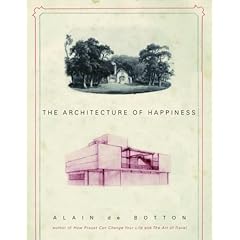
So, after something on the order of 5 months of reading, I finally finished Alain de Botton’s The Architecture of Happiness. I read it slowly not because it was a slog, not because I forced myself to get through it, but because it was truly delightful, and structured in a way that invites savoring in bite-size morsels. It’s definitely one of the best books I’ve read of late, and a real treat for anyone interested in design and/or architecture.
What impressed me most about the book was de Botton’s dedication to plumbing the depths of architectural history, considering that he’s not an architect, nor even a design critic, typically. He just seems to be a smart guy who writes books on subjects that intrigue, and it’s to our benefit that he chose a great topic with Architecture. He appreciates the prevalence of architecture in our lives, and the power it can have on us, our moods, our behavior… But because he’s not an architect, he doesn’t get caught up in the bullshit that practicing designers spread when talking about their stuff (and I’m as guilty of that as anyone).
What really puts the book over the top are the photographs used to illustrate points. I don’t know where or how he found his imagery (I’m guessing research assistants), but their appropriateness, and their own beauty, make taking in this book a singular pleasure.
Adaptive Path’s UX Week 2007 – The Best Ever
My colleague Sarah is the program chair for this year’s UX Week (August 13-16, Washington, D.C.), and she’s put together an amazing program.

The keynoters are particularly compelling. We’ve got Deborah Adler, who lead the design of the Target ClearRx pill bottle system, Jan Chipchase, a design researcher from Nokia, Lisa Strausfeld and her colleagues from Pentagram who worked on the interface for the $100 Laptop, and AP’s very own Dan Saffer.

Oh, and folks from CNN.com will present a case study on their new “Web 2.0” design.
Of course, that’s not all. Topics covered include:
- collaboration
- mobile device design
- research methods
- managing user experience teams
- evangelizing ideas
- participatory design
- hacking and prototyping
- rich interaction
- search engine interface
and much much more!
If this sounds like something for you, check out the UX Week page. Discounted registration ends July 13 (this Friday!) And if you register, use the promotional code FOPM (Friend of Peter Merholz) to get 15% off the registration price.
La experiencia ES el producto…
My Core77 piece, which has already been run on BusinessWeek’s site, has now been translated into Spanish by friends of mine in Chile. Fun!
Ratatou-eh
Last night, found myself in a packed house to see Pixar’s latest, Ratatouille. When I first heard about this movie, I was skeptical, and I’m not the kind of person who sees everything Pixar makes — I never bothered with Cars because it just looked boring. But the reviews, both from Official Media Sources, as well as People I Know, have been nothing less than glowing, so I psyched myself up for a fun night at the flicks.
Two hours later, I left the theater mildly amused, but utterly *stumped* at the adulation heaped upon it. Have our critical faculties suffered so much? The first thing Stacy said as we were leaving was, “Well, that was about 30 minutes too long.” There was so much needless plot, and really, needless TALKING. My main issue with the film is the heavy-handedness of the themes… It’s not enough that characters embody the themes in their behavior… every single thematic point is given it’s 15 minutes in the dialogue, so that we have characters telling us about following their passions, being torn between family, friends, and ideals, that anyone can succeed if they have verve, that we should love one another for who they are, not who we want them to be, etc. etc. There’s even a somewhat bizarre monologue on the nature of criticism, which vaunts critics who defend the new, though, really, there is nothing whatsoever new about Ratatouille — you couldn’t find a film packed with hoarier cliches.
Now, I don’t mind formulas and cliches — they’re what makes Hollywood go ’round. But they ought to be handled with a defter touch.
Now, all that said, I’d probably give this movie a 3 out of 5 stars… I basically enjoyed it, and there are some amazing scenes and set pieces. When the mechanics of the film are really clicking, it’s quite thrilling. Also, and I hate saying this because I hate dwelling on a films technical traits, but the quality with which rat behavior (movement, flow) was captured was startling.
Anyway, it’s a perfectly decent film, but in no way warrants the obsequious passion it’s fostered. Finding Nemo is still my favorite Pixar film, still the best intersection of action, adventure, humor, and, most importantly, heart (the last being a quality Ratatouille pretty much lacks.). Which is why I’m very much looking forward to next summers Wall-E, written and directed by Andrew Stanton, the major creative force behind Nemo.
Older is sometimes better
A great little story in this morning’s SF Chronicle about the maintenance of the wooden ladders the SF Fire Department uses.
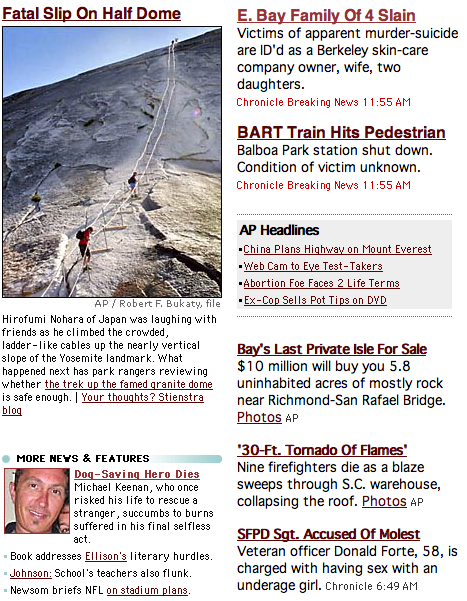
I read the news today, oh boy…
Here’s what’s on the front page of the SFGate right now:
Thud.
Have you ever seen a less inspiring NBA Finals? Was there a single memorable moment? Dear goodness. I love basketball and all, but the league’s gotta do something to make it interesting until the end.
Thoughts on seeing Helvetica
Last night, I was fortunate enough to see the new documentary film Helvetica. It’s an exploration of the typeface and how it’s been used.
My thoughts after seeing the film:
- Man, I think I do like Helvetica
- Rick Poynor might be the most well-spoken man ever
- Hot damn, Michael Bierut is funny… he might have the most screen time in the whole film
- Wow, Erik Spiekermann is kinduva prick
- Wow, David Carson is full of himself
- Hey! I know two people featured in the movie! (Michael Bierut and Jonathan Hoefler)
- Wow, I’ve never heard of this Mike Parker guy, but I *love* his energy… he’s a total geek for type!
- Matthew Carter seems genuinely cool
In all, it’s a good flick. Having worked in design for so long, and being such a nerd, my experience will be different than, well, someone walking off the street. It’s gorgeously shot (on DV, by the guy who shot Borat), and the designers (interviewees) are treated lovingly.
In the Q&A after the film, the director, Gary Hustwit, said something that was true that surprised me. He couldn’t think of any documentary film ever made about graphic design. And I think he was right. The closest I can think are some of the short films on design that the Eames made. And it’s bizarre and a shame that some of these brilliant influential creators (Vignelli, Matthew Carter, even that prick Spiekermann) have never been captured before. And shameful that there’s no doc chronicling the lives and expeirences of folks like Paul Rand and Saul Bass. As this film proves, designers are compelling subjects for doc film — they’re passionate, engaged, and have great things to look at.
…and it has a camera!
I’m intrigued by how after 4 separate iPhone ads, the fact that the device has a camera has yet to be mentioned.