Back in the day, I used to take many a thoughtwander. As I’m getting old and boring, they come fewer and farther between.
Recently I’ve found a couple threads that might tie together. The first deals with how people research product information online. The second concerns a hypertext pattern known as “The Cycle”.
I have been particularly keen on product research since I worked at Epinions.com, and watching numerous people try to find the right product to buy.
In our user tests, the archetypal task was to have people research digital cameras. Digital cameras are great because a) they’re common, b) not cheap, and c) somewhat complex.
Back in the day, fewer people knew much about them. We assumed that, given the task of finding an appropriate digital camera, people would whittle down the attributes such as price, megapixel count, and brand, and arrive at the few options best suited to them. If they had questions along the way, they could read helpful guides that would define terms, suggest comparison strategies, etc.
Again and again in our observations, that didn’t happen. People who knew little about digital cameras made no attempt to bone up. Instead they’d barrel through the taxonomy, usually beginning with a familiar brand, and get to a product page as quick as possible. It was only then, when looking at a specific item, and seeing what it’s basic specifications were, did they pause, sit back, and think, “Hmmm. This has 2 megapixels. I wonder how many I want?” Some would look for glossaries or guides, others would read reviews, and some just guessed by comparing the various products.
They would go through this cycle — looking at a product, reflect on their needs, understand concepts, look at another product, reflect again, etc. — a few times. Todd and I came up with a conceptual model, where the user is something like a bouncing ball, falling straight onto a product, then bouncing up, getting a lay of the land, falling onto another product, bouncing up again, but not as high since they’re starting to figure it out, falling onto another product, and repeating until they’ve found the right one.
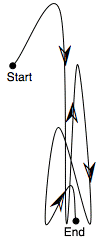
Three years later, and I’m researching how people acquire financial products, and I’m seeing the exact same things. People looking for a loan will head straight for the rates, even though they have no real understanding of what the rates mean, because they need something concrete to get their head around. Only then do they try to take this information and develop context for it.

The second thread in this thoughtwander comes from the world of hypertext theory, specifically Mark Bernstein’s Patterns of Hypertext. And specifically within that, The Cycle, where a reader returns to a previously visited node and departs on a new path. In a hypertext, this is how readers build their experience of context. By definition, you don’t read a hypertext from beginning to end, nor in some broad-to-narrow hierarchical fashion. You piece together an experience through exposure to its elements, and their relationships. Understanding relationships requires cycling through the material, returning to the same point more than once, and seeing how it’s all connected.
Well, that resonates with the behavior I’ve seen in product research. Websites tend to be designed rather rigidly and hierarchically, assuming visitors will be good little shoppers, and get a sense of all the basic concepts first (learn about megapixels, memory cards, battery life), then figure out their specific needs (I need a camera with 3 megapixels, using CompactFlash, that can take 50 pictures on a single charge), then find the products that meet those needs, and then choose one and be done. My observations suggest that the process is in fact much messier, and requires constant re-orientation on the part of the shopper to remember which variables are important and which qualities they want. (Something Amazon.com takes advantage of, whether intentionally or not.)
Tying these two together led me to wonder (wander?) whether something more fundamental is at play. At the most essential level, we’re seeing the behavior of decision making. How do I figure out what to do next? And decision making seems to rely on the piecemeal gathering of information and the contextualization of that information through their relationships. So, I did some searching on the web for “decision making” and quickly got overwhelmed. It turns out to be a vast and rich field, combining social psychology, applied psychology, economics, business, and lord knows what else. I had trouble understanding just where to begin.
Maybe you can help?
