House of the Snoring Filmgoers

I liked Hero (though it went on about 30 minutes too long). I think Zhang Ziyi is beautiful. The reviews have been favorable, so I got a group of folks together yesterday to head out to see House of the Flying Daggers.

It was terrible. It was unremittingly dull. It’s about 20 minutes worth of movie stretched out over two hours. We nearly considered leaving mid-way.

I mean, if you like extended shots of people on horses, this is the movie for you. The director makes very clear that these people are on horses, and are riding them for a very very long time.

But if you want emotion that has any feeling of truth behind it, forget it. And, no, I’m not seeking complexity in this film… But even the simplicity of the plot has no emotional logic, so you end up caught up in a love story that makes no sense.

Anyway, this is a deep deep disappointment of a film. And it’s pathetic that otherwise seasoned filmgoers (i.e., The Critics) would get snowed over by the cinematography to the point that they seem to forget they’re watching a movie, not staring at a painting. Carla Meyer is an exception, summing it up as “Beautiful but hollow.”

Content Management Workshop – January 25

On January 25th, Jeff and I will be presenting a workshop on getting the most out of your current (or planned) content management system.

We’ll be doing it here in San Francisco, at the new Adaptive Path office.

It should be a great event, and I can guarantee it will be chock full of useful information about handling the organizational politics of content management, how get people to think of content in a structured, and thus manageable way, the futility of much of what the big CMS vendors sell, etc.

In many ways, this is as much of an information architecture workshop as it is a content management workshop. (We believe that content management is, in large part, an information architecture issue). We’ll be addressing content models, taxonomies, facets, metadata of various sorts, etc.

This is a hands-on workshop, so there will be many activities to ensure that what you hear sinks in.

We have early registration that ends December 27th – save $50!

Hotel Room User Testing

A current project requires lab user testing in four cities in California. We knew that for the Bay Area, we could use our client’s office, but for L.A., Fresno, and Sacramento, what would we do?

Our first impulse was to get a formal user testing lab — totally pro set up, one-way glass, lots and lots of M&Ms. So we priced out a couple of labs in L.A., and the cheapest we could find was $1500 for a day. Which struck me as obscene.

And considering I hate testing facilities as it is. It’s sooooo corporate/conference-y. So foreign and weird.

So, instead, we booked adjoining hotel rooms. One serves as the testing room, the other as the observation room. Bring down a cheap, small, digital camera, and wire that to a TV in the observation room. Hotels are all about the high-speed internet access now, and Courtyard and Residence Inns by Marriott offer it for free.

Have the testing room be a suite, so that there’s a desk set-up in a room with no bed. (Otherwise, it feels a little too… porn-y.)

And hey, since you’re traveling, you need a hotel room for the night before (and possibly night of), so the rooms serve double duty.

Two adjoining hotel rooms run for around $300 for a day, depending on location. Even if it gets up to, oh, $500, that’s still a huge discount over a testing facility.

Why would I use a testing facility, again?

TiVo’s Slap in the Face of User Experience

I love my TiVo. And, as a user experience professional, I love what TiVo has done to offer a thoughtful, simple, straightforward, and streamlined interface. As such, I was looking forward to Matt’s interview with TiVo’s head of User Experience, Margret Schmidt.

And as such, I was disappointed by the pabulum spewed, the lack of informative detail, and the bizarre marketroid speak.

TiVo was offered a real opportunity to connect with the larger user experience community, and did little to take advantage of that.

There are two good things in the interview: Margret’s discussion of the TiVo design mantra’s, and the skip-to-tick incident.

There are two utterly mundane things in the interview: a warmed-over, uninsightful discussion of process, and the discussion of Requests for Enhancement.

There is one particularly frustrating thing in the interview: The phrase “Innovation is a by product of a talented team,” which is the not backed up in anyway. How do you put together a talented team? What is the makeup of your team?

There is one bizarre bit of marketroid speak that must have been the writing of a PR Flak, which I’ll just reprint fully:

It is actually pretty easy to balance the needs of the two groups, because in general they have the same goals.  Users want to watch quality programming when, where, and how they want to.  Studios want their programming enjoyed by the masses.  TiVo simply empowers users to control their TV consumption within the guidelines of fair use.  We have strong security system called TiVo Guard(TM) that protects the interests of the studios.  We don’t support the inappropriate distribution of copyrighted content, and our users aren’t asking for it.

Normal people don’t say “quality programming.” And the rest is a pathetic sop to the content industry. Shame!

There is one lie: “In general a feature won’t be ruled out as “too complex” because we have strong design team that can make anything easy to use.” The world’s strongest design team can’t make “anything” easy to use. There are moments of necessary complexity.

It’s unfortunate that TiVo wasn’t willing to truly engage with the design community on their work. It’s unclear if Ms. Schmidt simply cannot articulate what has actually lead to TiVo’s design success, or whether she was muzzled/blanded by an overzealous PR team. Either way, TiVo ends up looking worse in the eyes of the discriminating design community.

I hope they make up for it in their upcoming presentation to BayCHI, where perhaps, in such a forum, truth and honesty can bear out.

Methods and Masters

An ongoing discussion between JJG and I concerns the value of methods in design practice. At Adaptive Path, our “classic” workshop provides two days of presentation and hands-on activities. I’m a believer in the value of such methods and teaching as a “rising tide that lifts all boats.” JJG has been less convinced. In his ia/recon essay, he wrote “Research data and formalized methodologies don’t guarantee better architectures. Better architects guarantee better architectures.”

In the latest issue of the New Yorker, Atul Gawande writes an excellent piece on the quality of medical practice. One would think that, considering the quality of tools and technology, the fast spread of information, and the ability of the physicians, practice would be fairly uniform across treatment centers. Treatment of cystic fibrosis has been closely watched for decades, and the results show a bell curve of quality — some places do very well, most places are average, and a few are poor.

What the article mentions is that while the “best practices” in cystic fibrosis treatment have been widely disseminated, leading to average hospitals performing much better now than they did 10, 20, 40 years ago, those average hospitals are still average, and the best hospitals continue to far outpace them.

The reason? Driven, brilliant individuals who improvise, take risks, challenge conventional thinking, and are simply unwilling to settle for anything other than perfect.

In short, JJG and I are both right. The dissemination of successful methods does a lot to raise the average level. But the better practitioners will always far outpace the average.

A 21st Century Affliction: Media Obesity

The obesity epidemic is, in part, blamed on our evolutionary background. Our bodies favor high-calorie foods, which are now too easy to consume. (Obviously, there are other contributing factors, such as sedentary lifestyles.)

Obviously, not everyone succumbs to obesity. Personally, I have no desire to eat myself fat–I’m thin not because of willpower, but just because I have no inherent drive down that path.

But, that doesn’t mean I don’t have my weaknesses. And perhaps my strongest weakness (ha!) is the media.

I’ve been thinking about this because I was invited to a discussion predicated on this thesis:

As television moves from a linear broadcast experience to an on-demand one, we will soon be able to access 10,000’s of choices at a time. However, viewers already have a love/hate relationship with TV content: they want lots of options, but can never find anything they “want” to watch buried in the 100’s of channels and 1000’s of programs.

I realized that the “problem” in this thesis has it almost exactly wrong. Any new TiVo owner will tell you that they’ve got a long list of saved programs that they’re having trouble getting through. Not only can we find things that we “want” to watch, we have far far too much stuff we want to watch.

When I combine this access to desirable television with all the other forms of media, I’m awash in options: DVDs from Greencine (which I typically have for 1 or 2 months before I get around to them), books from the library (I often return them only partly read), RSS feeds from 149 websites (“Mark all as read” is becoming my friend), magazines, journals, web pages, and other books piling up.

It’s too much.

The problem is, I want it all. There’s good stuff throughout all this, informative, compelling, thought-provoking, entertaining.

It made me wonder if there’s an evolutionary precedent to media consumption the way there is to high-calorie consumption. I suppose that information gathering and processing could have been a valuable survival tool. There’s also the Media Equation aspect — with engage with media as if they were other people… and we are social beings… so this kind of media consumption might be tapping into our social nature.

Anyway, whatever the root causes, I’m feeling media obese. And obesity, in any form, is Not A Good Thing. I’m realizing I have to treat media with far higher discrimination than I do currently — and that this will mean ignoring that which is only good and relevant, and focusing only on the very good and very relevant. As a media junky, this restraint will be difficult. We’ll see how it goes.

Free Parking Isn’t

People, Parking, and Cities[PDF] is an essay from the latest Access magazine, published by the University of California Transportation Center. It’s an insightful look at issues of parking, density, and the urban experience. To whet your interest:

THE POP CULTURE IMAGE of Los Angeles is an ocean of malls, cars, and exit ramps; of humorless tract homes and isolated individuals whose only solace is aimless driving on endless freeways. From Joan Didion to the Sierra Club, LA has been held up as a poster child of sprawl.

This is an arresting and romantic narrative, but also largely untrue. To the extent that anyone has a definition of sprawl, it usually revolves around the absence of density, and Los Angeles has since the 1980s been the densest urbanized area in the United States. This would make it the least sprawling city in America. Compared to other US cities, LA also does not have inordinately high rates of automobile ownership.

My new favorite thing: The Sun

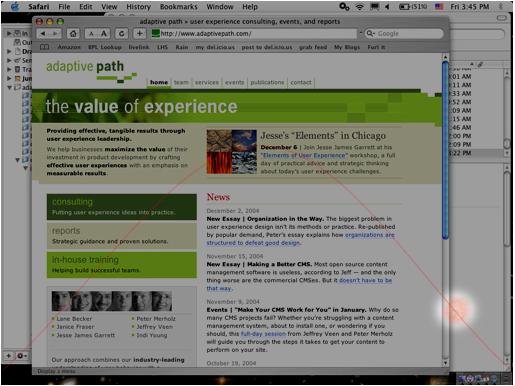
So, a couple of weeks ago, I downloaded Konfabulator. It’s a system that allows you to place all kinds of tools and widgets on your computer, and access those tools without having to launch applications.

There seem to be any number of practical uses, none of which interests me. What I’ve gotten the most out of is “Sun.” As the description says, “Simulates the motion of the sun across your desktop.” That’s all it does. And I love it.

Here’s a screenshot:
thesun_withline
I’ve muted the bulk of my screen to better highlight the Sun, and I drew a red line that shows its course over a day.

I keep the sun permanently above everything else, but with a lot of transparency so I can see through it to my other stuff. I love having this bit of the “real world” impose itself over my electronic domain. This is the kind of thing that would probably give French critical theorists a field day.