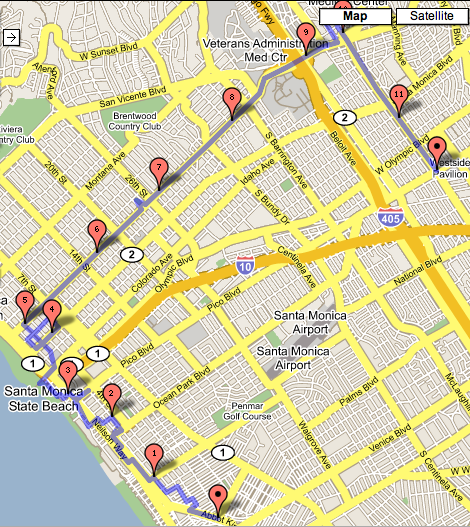
According to the Google Maps pedometer, I clocked 11.6 miles of walking today:
A bunch of photos are up on Flickr. Some favorites.
Thoughts and essays from the guy who coined the word "blog."
According to the Google Maps pedometer, I clocked 11.6 miles of walking today:
A bunch of photos are up on Flickr. Some favorites.
It’s interesting seeing the web 2.0 discussion bifurcate. The technologists seem to feel that “Web 2.0 is about making websites machine readable so that content can squirt seamlessly between unrelated sites. Technologies like RSS, RESTian APIs, and XHTML/CSS are the core of Web 2.0.”
The designers are waking up and saying, “No! It’s about the improved experience!”
Considering the technologists got there first, this is one of the reasons that, in the back of my mind, I’ve been nervous talking about “Web 2.0” when I refer to the trends we’re seeing. My initial effort to label it something else (“designing for the sandbox“) understandably didn’t take root (it’s too opaque, and requires a concerted marketing effort).
It feels like the phrase “Web 2.0” is definitely here to stay. And with it, the challenge for designers to make technologists understand that Web 2.0 isn’t interesting because it makes “the Internet useful for computers,” (as Jeff Bezos said), but it’s interesting because it further empowers *users*. This is the underlying theme to Josh Porter and Richard McManus’ recent “Web 2.0 for Designers” piece.
And I think a way for the technologists and designers to hold hands is to go a level deeper and realize their shared philosophies. In June I wrote an essay for the Adaptive Path site on relinquishing control (and giving users the power to dictate their experiences). A month later, DeWitt Clinton, a software developer, wrote, “Web 2.0 is giving up control.” He then gets jiggy with acronyms (REST, SOAP, API, etc.) but, truly, we’re talking about the same thing.
I’m looking forward to the upcoming Web 2.0 conference as an opportunity to explicitly bridge these worlds. The challenge then being, how do we spread the word?
I’m heading south on Sunday the 28th, and will be there until the morning of Thursday the 1st. Should we hang out? Email me: peterme at peterme dot com.
Adaptive Path is experimenting with having a public wiki during our User Experience Week conference. (Courtesy of our pals at Socialtext.)
On the wiki, you can read notes from each of the sessions (say, Ajax, a case study on Wells Fargo’s content efforts, and field research), find attendee’s weblogs, learn about jobs in the DC area, birds of a feather discussions on intranets and cultural change, and photos from Flickr.
It’s worked out… pretty good. Not great (it’s not clear *when* you should use the wiki, not everyone has a laptop, etc. etc.), but I think for those who have used it, it’s been pretty beneficial.
Tomorrow morning I head to the land of the security lockdown, where we’re hosting our User Experience Week.
On Tuesday, August 23rd, we’re hosting beers at Fado, 808 7th Street NW, from 5:30 until we cannot stand no more. Please join us!
Here. Though, if you don’t care anything about the internet industry, it won’t mean anything to you.
This week’s Economist features a story on Yahoo!’s Personality Crisis. (scroll down a very little bit — it’s a cut and paste into someone’s blog.)
It very much touches on the philosophical issues of Web 2.0 bandied about of late. The story’s main thesis being that while Yahoo! attempts to match Google in terms of openness (acquisition of Flickr, etc.), such openness is in direct conflict with its business model — which is one of a media company that seeks to be “The only place anyone needs to go to find anything, communicate with anyone, or buy anything.”
I’ve argued before that Yahoo is not a sandbox company. I was refuted with calls of, “But what about these APIs? What about Flickr?” And in response to the Economist’s article, folks like Jeremy Zawodny plead, “Look at what we did with My Yahoo!. Check Yahoo! News. Not to mention the bazillions of RSS feeds we’ve been pumping out: News, Search, Flickr, Finance, Groups, 360, My Web, and more. Yahoo! is probably one of the biggest f’ing aggregators of third party content in the world.”
But that’s exactly the Economist’s point. There’s no personality crisis if Yahoo *isn’t* attempting openness. But these refutations strike me as small potatoes in the megalith that is Yahoo! And endeavors such as bulking up Yahoo’s presence in southern California strikes at the very heart of this conflict. Hollywood is not known for its open philosophy when it comes to content.
Clearly, it will take time before Yahoo figures itself out. But in the meantime, I encourage people at Yahoo to take the Economist’s article seriously. If you can’t recognize this inherent internal tugging, then you’re simply fooling yourselves.

I believe it was Erika Hall who first said that, “what cosmopolitans were to the dot boom, mojitos are to Web 2.0.”
[[Hello, Scobleizers! If you like this post, you might want to read:
Web 2.0 – It’s not about the technology
Designing for the Sandbox – slides from my presentation
Designing for the Sandbox – the original post
How I Learned to Stop Worrying and Relinquish Control]]
Rashmi challenges my philosophical bent with her writeup of the web 2.0 panel:
In my opinion, the logic (philosophy if you will) of Web 2.0 reflects its technological underpinnings. A good example is the open source movement. Now, we even have open source beer. But initially, to understand the philosophy of open-source you had to understand developer speak. As Stewart Butterfield noted at the panel, Flickr wanted rich interactivity (refreshing parts of the page at a time) so they had API hooks – they kind of went with it, rather than fighting it. The API’s facilitated the openness. Currently, the logic behind Web 2.0 is baked into API’s, RSS etc. Also, I question whether any business will move to this approach because it is a compelling philosophy. They will shift because it is an attractive business proposition, or because technically it makes sense/is unavoidable, or a mix of both.)
But I think this is exactly backwards. Open source didn’t require developer speak. As Eric Raymond showed, he had to get *developers* to understand open source by using metaphors of cathedrals and bazaars. The conceptual underpinnings are not predicated on the technology.
APIs facilitate openness, but they’re meaningless if your organization doesn’t have the conceptual underpinnings to take advantage of it. And while the “logic” of Web 2.0 might be baked into APIs, RSS, etc. (and I’m not so sure about that), the approach is not.
If business shifts to this approach *without* appreciating the compelling philosophy, well, they’ll fuck it up. They’ll fuck it up the way that Barnes and Noble did when they simply tried to copy Amazon’s features. The point isn’t the features, it’s the underlying philosophy of relinquishing control. Since Barnes and Noble as a company didn’t appreciate the philosophy, they invested a lot of time and energy into features that then languished. Same thing with Blockbuster. They tried to copy Netflix’ policy of No Late Fees — but because they don’t have the philosophical underpinnings in place, they fucked it up, and now have to post big “End of Late Fees Terms” links on their home page, because customers were getting confused when, after having a DVD for a week, they found out they were then charged the COST of that DVD.
As Ross made clear, simply adopting Web 2.0 technologies does not make you a Web 2.0 enterprise.
In fact, I’m a little distressed that the program chair for BayCHI (the “H” stands for “Human”!) would express such… technological determinism about this. As Paul Rademacher said on the panel — these technologies have been around for at least 5 years… They’re being adopted *because* the philosophy is starting to spread…
William Rohrbach wrote the following to Adaptive Path’s general contact address. The “Q” and “A” part is a quote from the added material to Jesse’s Ajax essay.
“Q. Did Adaptive Path invent Ajax? Did Google? Did Adaptive Path help build Google’s Ajax applications?
A. Neither Adaptive Path nor Google invented Ajax. Google’s recent products are simply the highest-profile examples of Ajax applications. Adaptive Path was not involved in the development of Google’s Ajax applications, but we have been doing Ajax work for some of our other clients.”
Ahhh… maybe you should mention where Ajax had its genesis…specifically Microsoft. Or as assholes like you call them M$.
And the highest-profile example of Ajax and still the best is Outlook Web client.
Fucking open-source pansy loving shit fuck pricks.
That last line is become our new motto.


