Category: Uncategorized
Obscure DVDs – Where’s “The Long Tail”?
Today’s New York Times has an article on how obscure DVDs have a precarious future in a world dominated by big box stores. I find it a little disconcerting, because one of the great things about the DVD market is how it made obscure international and older films available.
What’s missing from this article, though, is any discussion of online retailers or Netflix, which I find bizarre, as The Long Tail is predicated on how the infinite shelf space of online stores means there’s a market (though possibly a very very small one) for anything. Are Amazon and Netflix unable to provide enough of a market for these DVD distributors? Or is something else going on here?
Snacklash
Research and Design in Second Life
Adaptive Path has been given a marvelous opportunity, working with the folks at Second Life on ways to improve the experience in-world. So, true to a smart user-centered design process, we’re conducting research — in world! If this process intrigues you, then read our Second Life posts on the Adaptive Path blog.
Michael Pollan and John Mackey LIVE AND IN CONCERT
Tonight I saw Michael Pollan, the author of The Omnivore’s Dilemma, and his arch-nemesis John Mackey, CEO of Whole Foods, live on stage in Berkeley.
At some point, the webcast will be made available here.
Okay, so I’m overplaying the arch-nemesis bit, the series of open letters between Michael Pollan and John Mackey, begun by Mackey in response to The Omnivore’s Dilemma, suggested that all was not sympatico. (Michael Pollan’s first letter, and his second letter.)
Mackey’s Powerpoint
For the first 45 minutes of the event, Mackey gave a (remarkably poorly designed) Powerpoint presentation covering what he calls the 6 ages of food production. He focused on the last two — the Industrial Age (which we’re still in, but he hopes we’re getting out of) and the Ecological Age (which he sees Whole Foods as a leader in engaging).
Mackey also showed remarkably disturbing video of factory animal husbandry. While the conditions are clearly terrible for animals, my primary thought was, “What does this do to the psyches of the people who work with these animals?”
The Powerpoint was followed by a discussion between Pollan and Mackey on stage. Not surprisingly, the two by-and-large agree on everything.
Some interesting new developments at Whole Foods
Whole Foods has started a $30 million venture capital fund to support unique food artisans around the world.
Whole Foods will be collaborating with Transfair (the Fair Trade certifiers) to develop a “Whole Trade Guarantee,” so you can feel better about the sourcing of your food.
Some thoughts inspired by the discussion
Originally, the event was supposed to be in a 700 person auditorium, but it sold out in a matter of hours. So it moved to a 2,200 theater, and sold out in less than a week. Now, part of this is that we’re in Berkeley, which probably is the city that has been most serious about it’s food for the longest time. But there’s clearly something going on here.
Pollan and Mackey talked about a desire to bring complete transparency to the food your eating. Pollan alluded to what Denmark has done, where, with a second bar code on your food, you can call up highly specific information about where your food came from — specific feed lots, etc. (Pollan mentions this in this article.) All I could think about was food as spime, and the challenges information architects would have in making this immense about of information about what we eat, um, digestible (ha!) by consumers.
Handsome family

Stacy’s brother Mike, and his wife Lara visited us this past week. We had a great time with them, showing them all around the Bay Area (and them showing themselves the delights of Napa). We took this photo at the end of the week, and, well, I’m pleased with the picture.
Even more on No Job Titles
Quite a bit back, I wrote on the subject of “No Job Titles.” The subject has come up again within Adaptive Path, as Todd’s post shows. There’s also been discussion on internal mailing lists, which prompted me to write the following:
I hate job titles.
I wish we could no longer have them for two reasons:
1) People get their identities so wrapped up in their job titles. There’s a reason “creative director” is banned from Adaptive Path. As I wrote in that long interview/discussion with GK van Patter:
“The moment we attach our identity to a label (“designer,” “information architect,” “engineer,” “New Yorker,” “San Franciscan,” “Catholic,” “Jew”) we lose perspective.”
2) Job titles suggest to clients and other external people that we are like other companies.
Adaptive Path succeeds best when we act in ways that are *not* typical for a company, particularly a services firm. Job titles is Playing the Game, and it allows a client to assume we are like our “competitors” because we have titles like they do. If we go into a meeting with no titles, that will tell potential clients/partners that we are different from what they’re used to dealing with.And that’s a good thing. If the client is ready for different, great, let’s bring it on. If the client is not ready for different, we probably don’t want to engage.
(I use “competitors” in quotes not to suggest no one can compete with us, but because we have such a hard time defining who our competitors are…)
Something else I thought about today, talking to various companies in Minneapolis, is that job titles are particularly useless in our knowledge and services economy. Things are so fluid, and all that such labels do is put people in a box that probably doesn’t suit them.
peterme’s 2007 US tour
In the next few months, I’m traveling all around North America:
Next week (Feb 19-23): Minneapolis, MN
March 9-13: Austin, TX (for South by Southwest)
March 22-26: Las Vegas (for the IA Summit)
April 12-14: Ottawa, Ontario, Canada (for CapCHI)
April 15-20: New York, NY (networking and Gel Conference)
May 17 (and probably time around it): Atlanta, GA (for Atlanta CHI)
August 14-17 (or so): Washington, D.C. (UX Week)
If you are in these places, and we should meet, email me (peterme AT peterme DOT com)!
Go See Children of Men
I finally got around to seeing Children of Men last night, and if you’ve been considering seeing it, are on the fence, I implore you to go and catch it in a theater before it disappears. It’s a good film, and a cinematographic treat. You will definitely lose something if you wait to see it on DVD.
Now, I wanna talk about the film, so I’ll put the rest of my thoughts after the jump…
Continue reading “Go See Children of Men“
Jakob Jumps The Shark
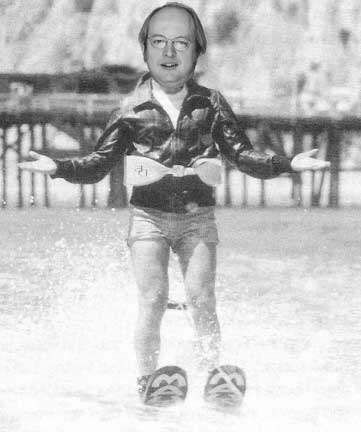
In the distant past, I would laud Jakob when he was being pilloried by the masses. But then, Jakob’s brand of rhetoric moved away from reasoned discussion of design, and he started venturing into areas he has no expertise in, such as ROI. Scott Hirsch and I tore apart his pathetically flimsy “Usability ROI” report, as it had no grounding in anything resembling financial practice.
And then, more recently, I’ve objected to his essays where he makes specious claims seemingly for the sole purpose of puffing up his events, and his comments that suggest he hasn’t appreciated how the Web has evolved in the last 6 years.
But, wow, what a last straw is his latest essay, where he claims “In one example, a state agency could get an ROI of 22,000% by fixing a basic usability problem.” If he hadn’t jumped the shark before, he really has now. He backs this outrageous claim with a remarkably naive cost-benefit analysis, the kind of financial fiddling that no serious finance director within any organization would believe. (At Adaptive Path we actually conducted research with a range of organizations on how they do such math, and these kinds of multiplying-lots-of-little-numbers-to-make-a-big-number kind of math never holds water.)
I wouldn’t write about it except that I fear that Jakob is turning into a pernicious force when it comes to advancing the field of design, because his reach means tens of thousands of people are reading this unsubstantiated crap. Such outrageous claims truly feel like the wild flailings of increasing irrelevance.
8 years ago, the web had two usability prophets – Jakob and Jared. Had you asked me to place bets on which one was worthier to follow, I would have said Jakob (UIE’s “Web Site Usability” book pissed me off). But in the last 4 or 5 years, Jakob has receded to the point of almost total irrelevance, whereas Jared and his gang are pursuing important and interesting questions, and never making specious claims about what they’ve found. Ditch alertbox and subscribe to Brain Sparks.