Visiting Dublin, Ireland and Edinburgh, Scotland (and points proximate)

Stacy and I, for a belated honeymoon-type thing, are planning on visiting Ireland and Scotland from June 8-23. We fly in and out of Dublin, and would like to see Dublin and its environs, and then hop over to Scotland for some Edinburghian and possibly Glaswegian splendor.

Of course, we really don’t know what we’re doing. We will soon be cracking open guidebooks and the like, but I call upon the power of the internet to provide suggestions for what we should consider. Thanks!


The Rise of the Networked Neighborhood

Earlier today I attended a presentation by Bernt Wahl on the work he’s doing specifying neighborhood geodata. A masters’ project for UC Berkeley’s iSchool, it also seems to be what underlies the business Factle.

Maps tend to be geared around discrete entities such as streets, zip codes, city boundaries, county boundaries, etc. Neighborhoods have proved remarkably challenging, because they are far more subjective. Cracking the neighborhood nut, though, could be immensely rewarding, because people, at least in cities of significant size, tend to think in terms of neighborhoods.

This is something real estate agents figured out long ago (and one of the reasons Trulia was an early user of Factle’s data.) In some work that Adaptive Path just completed for a local-search-information company (you know who they are, but we can’t reveal it yet), we worked with them to bolster their coverage of neighborhoods, because neighborhoods are often a more important means of identity than city.

A few years ago I attended a lecture by Manuel Castells where he discussed the global city (I wrote my notes here.) His thesis was that there are emergent global connected cities which have greater meaning to their residents than the states or nations in which the cities are located. San Franciscans have more in common with New Yorkers and Londoners and Barcelonans than they do with people who live in, oh, Modesto.

Listening to Bernt’s lecture, I realized that this connection probably needs to go the neighborhood level. If I think about Oakland, people who live in Temescal are more in tuned with the people who live in South Congress in Austin, or the Hawthorne District in Portland, than they do with folks in West Oakland or East Oakland. When I travel, a big chunk of time is spent trying to find *neighborhoods* that I like, can hang out in, drink coffee, shop, etc. And thanks to the internet and relatively cheap travel (rising gas prices notwithstanding), we’re seeing the development of global connected neighborhoods, with distinct identities, perspectives mindsets. The lofty, modern, design-conscious, locally-sourced-food mentality of Portland’s Pearl District resembles Austin’s new 2nd Street or Berkeley’s 4th Street.

Thinking about the Rise of the Networked Neighborhood sheds an interesting light on subjects that warrant approaching at a level more granular than that of the city. The subjectivity of neighborhoods make such comparisons messy, but interesting.

Married.

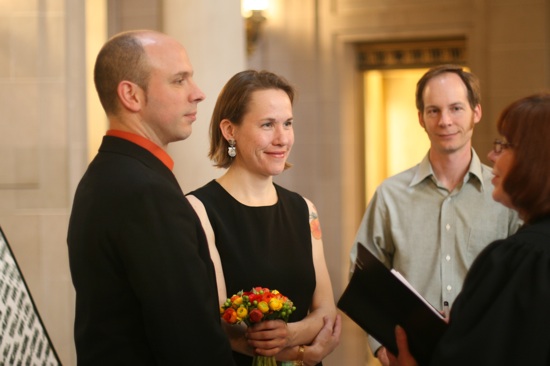
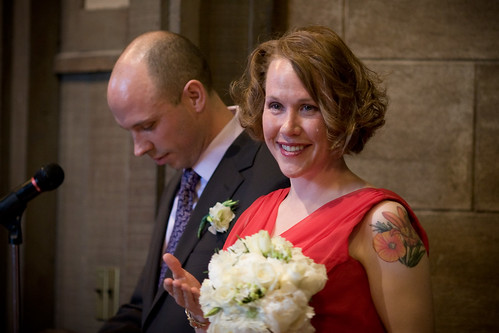
Among the many reasons I’ve been posting so infrequently was wedding planning. My own. Last Saturday, Stacy and I conducted our ceremony at the Hillside Club in Berkeley.

Ryan posted a set of 16 beautiful photos from the event.

To be truly forthcoming, Stacy and I were already technically married, having done a San Francisco City Hall ceremony on February 15, the 6th anniversary of our commitment to one another.


(Photo by Maggie Mason)

Saturday’s ceremony was a blast. Stacy and I were both quite anxious, but we were also able to be very present during the event. My favorite photo of the event demonstrates this:

When you can double over laughing in your own wedding ceremony, things are going well.

Our guests protested over how much food we served them at dinner (a meal prepared by our favorite East Bay Chinese restaurant, China Village.) Yet when the 140 cupcakes appeared (more than one for each person), they were pretty much all eaten. Hmmmm.

We began the event with a slideshow. The slideshow had a surprise for some people, and that surprise is another reason why I’ve perhaps not been as on the ball when it comes to writing here.

Stacy and I are expecting a boy.

2008 is a liminal year. Stacy, we’re gonna have an adventure!

(I’ve turned comments off for this post.)

Design will have a seat at the table – what do we do with it?

Of late, there’s been some discussion about whether the role of design will have a seat at the table — you know the table, the large mahogany one where all the important decisions are made.

Adaptive Path’s search for a CEO (or, as one candidate put it to me yesterday, “It’s like your adopting a parent,”) has given me many opportunities to discuss the role and value of design. One of the criteria we have for a CEO is to help us enter new markets, and as part of that, to communicate the value of experience design at higher levels of the organization.

Adaptive Path is built on a foundation of balancing strategy and design. We think our strategy work is better because we know what it will take to execute, and we think our design work is better because it respects the strategic context in which it is placed. A concern I have, with bringing on a CEO, and asking that person to get us involved in C- and board-level discussions, is that our work would begin to tip toward strategy. It’s commonly believed that strategy is where the money is, where the higher billing rates are, and it’s natural to want to shift focus toward the higher margin work.

In one of my conversations, though, I was talking about how we’re currently getting greater exposure to the C-level. While we’ve always had C-level relationships with the startups we worked with, in 2007, we started developing those relationships with billion dollar companies whose names you’d recognize. And those relationships were borne directly from our design work.

These are companies that have recognized that their primary value, the main thing they have to offer customers, is the experience they deliver. Internet pureplays have had to understand this before everyone else, because, typically, their service is free (as is their competitors, so switching is pretty easy), and so they must compel with the one thing they have – a website experience.

In a later post I hope to plumb into more details (and set experience design work in opposition of brand/marketing design approaches), but what I wanted to get across here is that experience design will have a seat at the table, because in a service economy, the quality of experience connects directly to value. Many experience designers can keep doing what they’re doing and they will find themselves talking to more VPs, then C-level execs, and even boards. It should get interesting.

UX Week 2008 Is Taking Over My Life

About a month ago I wrote about the progress we’re making planning the conference UX Week 2008. I feel a little sheepish plugging Adaptive Path events on my blog (you’re not here to be sold at!) but it really is a big part of what I’m doing and thinking… And if that’s not what this blog is for, I don’t know what is!

What I’m trying to do here is help put together the premiere user experience conference bar none. One of the first things we realized is that in order to do that, we need a mix of inspiration and information. So the mornings are single-track main stage talks that should appeal to all, and in the afternoons of days 1 and 2, we offer 3 hour skills-building workshops. We’ve recently added workshop on sketching for interaction design, and Indi’s mental models.

We also have a responsibility to point the way forward for the user experience discipline. One piece of feedback we’ve consistently gotten at AP is that folks look to us to know where things are headed. That’s why the last day is devoted to the Future of User Experience, and is coming together as a day on what I (half-jokingly) call Our Glorious Ubiquitous Future. We’ve got everything from designing for mobile, robots, gesture, and large-scale multi-touch. We’ll talk about the future of the browser, and explore the realm of alternate reality games. Much of this might seem far out now, but it’s clear that in 3-5 years, we will need to be ready to design for these contexts. Will we be ready?

And, of course, a conference on experience design can’t be *all* work (but don’t tell your boss!). Day 3 begins with a series of sessions on immersive experience design, which is then followed by our Exploratorium field trip. This isn’t meant to be down time so much as an opportunity to shift gears, to consider experience design from multiple perspectives.

Lastly, I’m really excited about how Day 2 is shaping up. Starting with a keynote by the CEO of Zipcar, we then move into a day devoted to media and service design. We take on media and politics with sessions from Audrey Chen, senior information architect of TheDailyShow.com (she’ll share what it took to put their complete archives online), and Dave Wolf from Cynergy, a company that developed a brilliant conceptual prototype of designing for democracy in the 21st century called Ben (after Ben Franklin). We then follow that up with explorations on service design, and wrap up the day with a discussion of how Milkshake Media developed the LIVESTRONG brand experience.

I’m honestly giddy about what we’re getting together for this event. It’s going to be inspiring, informative, fun, and doubtless exhausting. I hope to see you there!

Register with promotional code FOPM and receive 15% off the registration price. That price goes up after April 30, so register now and save!

20 Minute Book Review: Pictures at a Revolution

(20 minutes is the length of my BART commute.)

All Americans know that 1967 was a heady time of the country. “The Sixties” were in full swing, and the gap between the Baby Boomers and their parent generation was startlingly wide. Studying the pop culture of the time can reveal interesting sociological trends. While mainstream music had already been thoroughly upended, mainstream cinema still largely trafficked in the pabulum from what was increasingly a bygone era.

I just completed the best book I’ve read so far this year, Pictures at the Revolution, by Mark Harris. I first heard about the book on a podcast of KCRW’s The Treatment, where its author was interviewed. I waited for the copy to become available at my local library, and dove in. The book is little more than a historical take on the five Best Picture nominees to emerge from that year — Guess Who’s Coming To Dinner, In The Heat of the Night, The Graduate, Bonnie and Clyde, and, most notoriously, Doctor Dolittle. These nominations represent the divide occurring in Hollywood at the time, with Dinner and Dolittle representing the older generation, Graduate and Clyde the new generation, and Heat balancing between the two.

Both The Graduate and Bonnie and Clyde are considered the ultimate capturers of their Zeitgeist, so it comes as something of a surprise to find out both had their genesis in 1964, and that it took quite a while to get those stories to the screen. It intrigues me that those are the only films of this bunch to have a lasting presence in the canon — I suspect that these films aren’t so much of their time as being of all time, a Rorschach test that allows any filmgoer to read their contemporary concerns into the narrative.

Bonnie and Clyde easily had the most fascinating gestation — beginning as an homage to the French New Wave, it was very nearly directed by Truffaut, and then Godard, before it finally made its way to Arthur Penn. The Graduate was always protected by the supreme confidence of its director, Mike Nichols, who knew exactly what he wanted, even if he couldn’t articulate it. Heat struggled with social relevance in a time when Hollywood still wasn’t comfortable making bold statements. Dinner was little more than an excuse to have Tracy and Hepburn make one last film. And Dolittle was a disaster from the word go — filled with lessons about what not to do, particularly hiring mercurial prima donnas.

The most poignant story in the book is Sydney Poitier’s. He stars in two of the films (Heat and Dinner) and was considered for a third (Dolittle). Sydney had won an Academy Award, and by the end of 1967 was the top-grossing star in Hollywood. However, he simply couldn’t break free of the typecasting of the neutered irreproachable Negro, and as social mores evolved, he found himself caught in the middle. He suffered the classic innovator’s dilemma — the things about him that allowed him to succeed in the early and mid-60s were exactly the things that rendered him irrelevant as the decade wore on. It’s disheartening because Poitier was very much aware of this, and couldn’t break free from this reality — he was literally damned if he did and damned if he didn’t.

There are a lot of good stories winding throughout the book — Warren Beatty’s increasing chutzpah to produce Bonnie and Clyde, the casting of Dustin Hoffman against all conventional wisdom, the establishment of color photography as a medium for stark social commentary (and not just boisterous musicals or Westerns), Benton and Newman’s ascendance from contributors at Esquire to full-fledged filmmakers, etc. etc. It’s a long book (near 450 pages), but moves briskly, and is always entertaining. If you dig films, and Hollywood, it’s definitely worth perusing.

And now I’m at my stop. Until next time!
Adaptive Path is looking for a CEO

As we’ve just announced over on the Adaptive Path blog, we’re looking for a CEO. Jesse and I aren’t stepping down or anything — we’ll still be Presidents. But we’ve recognized that as the company evolves, and complexifies in interesting ways (more people, more offices, more opportunities), we’d love an experienced hand help us navigate.

I tend to think about it as “What do you geek out to?” When I geek out, it’s to experience design practice, events programming, supporting the team. I don’t geek out to Running A Business. We’re looking for someone who geeks out to Running A Business, and who appreciates the impact that design can bring to the world.

We also figure that we probably know the right person for the job, or we know someone who knows that person, which is why we’ve decided to take the search to the public. If you know of someone, or are that someone, don’t hesitate to email my colleague Bryan at bryan dot mason at adaptivepath dot com.

Incompetence

Apart from government positions, is there any job in the public eye so wracked with incompetent practitioners as NBA referees? The final call in regulation that screwed the Raptors is just the latest in an overwhelming display of incompetence.

I tend to agree with my dad that referees don’t determine the outcome of games (there are too many things that happen in the prior 48 minutes to say it all rests on one final play), but the number of blatantly bad calls you see in a single game is startling. Is there no accountability in the NBA? How is the performance of these refs judged?

Bend your mind around Messrs Jones and Freitas

Recently, my colleague Ryan conducted a two-hour IM chat session with Matt Jones. You can read the highlights over in the Adaptive Path blog, but if you have the time, I encourage you to delve into the unexpurgated version available on Ryan’s site.

Their dialogue triggered a few associative notions in my own mind that I thought I’d share.

When Matt talks about Jyri talking about social objects and their genesis in Actor-Network Theory, he cites the photo in Flickr as the canonical social object. I believe the door-closer to be the canonical social object, as described in Jim Johnson’s seminal essay Mixing Humans and Nonhumans Together: The Sociology of a Door-Closer. (Don’t tell anyone, but the PDF is available for download here.) It’s a bizarre essay, not the least because Jim Johnson is a pseudonym for Bruno Latour, who felt that in order for a American audience to care about what he wrote, he needed to write in an American persona.

Jones goes on to (lament? exhort? simply note?) the “gravity well of the iPhone” dominating the UI landscape and making it hard for other innovations to be noticed. One thing that is patently obvious is that about 12 years ago that happened with the Web, and we’re only now just emerging from the haze of desktop-networked-browser-based-environment design to recognize there’s more to the world than point and clicking on form fields. The Web has been a great thing, but it also obscured very real innovative work being done in user experience design over the last decade that only now is coming to light.

Anyone interested in personal informatics needs to read Ryan and Matt’s interview, as it delves into, out of, and across that subject more than I’ve seen in any one place. I was also pleased to be pointed to Rescue Time, a system for visualizing your computer usage. Matt comments about Rescue Time extending off the desktop, as “scary perhaps…” but I think it’s inevitable, and potentially powerful. We leave so many data trails (they also talk about Nike +), that having a personal dashboard that visualizes my quantified self could prove extremely beneficial. (I’ll write an exceedingly long blog post about that one of these days.)

This interchange stopped me…

RF: All of this data is hidden from us, and we’re the one’s generating it… we aren’t equipped, cognitively, to learn anything more than impressions from our own actions. In attempting to gather more complete pictures of our behaviors – and gain better analysis of ourselves – whats our motivation?

MJ: Well – coming back to the social aspect. The overlays of these patterns with those of others are a new kind of feedback we haven’t had at any scale before. And we do flock well…

…I hadn’t thought of it in this way, and I don’t know how purposeful Matt’s use of “flock” was, but this is all about emergent behaviors that arise from the intersection of all these little local behaviors. “Flock” triggered a memory of Mitch Resnick’s Turtles, Termites, and Traffic Jams wherein he begins the book discussing flocking behavior in birds, and how it is an emergent behavior — there is no “leader” that the others follow… There is a set of rules that individuals follow, and in doing so, what emerges is the group flocks.

And let me say, I’d be the first in line to buy “Who Moved My Siege Engine”.

Alan Cooper Told The Audience What They Wanted To Hear, Not What They Needed To Hear

A couple nights ago I saw Alan Cooper present his Interaction08 Keynote, An Insurgency of Quality, for a local audience.

His presentation is quite rambly, but I think the heart of the thesis was:

  • best-to-market always beats first-to-market
  • quality takes time
  • interaction designers are craftspeople
  • programmers are craftspeople
  • business management is optimized for an industrial economy; they don’t know how to handle a post-industrial economy
  • interaction designers and programmers should join forces and make great things, and success will follow

Alan makes a lot of good points in his talk (many of which we make at Adaptive Path, such as how thoughtful design allowed iPod and Palm to beat predecessors, the value of distinguishing between design engineering and production engineering, and the value of the Quick Win), but he lost me when he advocated ignoring the business folks because they simply won’t get it. Not just “don’t” get it, but “won’t” get it. He seems to think that business folks are wired in such a way that they can’t handle the post-industrial economy. He also believes that attempts to quantify business value of post-industrial work is a fool’s errand.

He basically told the audience what they want to hear, but not what they need to hear.

I tried to respond in a comment/question, arguing that the IxDs and programmers need to join forces with savvy business folks who can champion their cause. And that IxDs and programmers rarely express any interest in being held accountable, and that’s why business people have the power — they’re willing to put their butt in the sling. He misunderstood my comment about accountability and construed it as a comment about return on investment, and he got all rambly about quantification. Accountability is not necessarily about ROI — in fact, many business folks that ROI and NPV are typically just tools to CYA. But, what we saw in our 2003 research on ROI and User Experience is that the act of making a rigorous connection between design interventions and driving real business value (however that value is defined in that organization) leads not just to business success, but often better, and more useful design.

More than anything else, this talk exposed the interaction design profession’s neuroses around dealing with the larger world of business, and I suspect Alan’s frustration in dealing with “business people” has lead him to want to neglect them altogether. He is fortunate to be in a position where he can do that… But I fear if anyone were to try to follow his suggestions they’d find themselves marginalized and angry as all their brilliance goes for naught.