FBI: Celebrating Fanatical Suspicion

I continue to be appalled at the lionizing inherent in naming the Federal Bureau of Investigation’s headquarters the J. Edgar Hoover Building. Hoover was, let’s face it, an evil man, or, if not evil, deserving of no end of contempt. The Chronicle today has an article on how Hoover targeted Mario Savio, the spokesicon for Berkeley’s Free Speech Movement, and in the past offered a special report, “Reagan, Hoover, and The UC Red Scare”, delving into how Hoover targeted UC president Clark Kerr, surreptitiously destroying his career.

And it doesn’t take much to find Hoover’s other contemptible deeds.

Does Cluster Analysis Cut the Mustard?

Malcolm Gladwell’s article, “The Ketchup Conundrum” offers an intriguing look at the intersection of marketing and cognitive science. The basic thesis revolves around how a seemingly infinite variety of products have emerged to satisfy discrete differences in consumers’ desires — so whereas 40 years ago, if you wanted mustard, you got French’s, now the mustard market is sliced and diced along a variety of vectors — color, spiciness, tanginess, etc. — with a product to suit most everyone.

Originally companies made One Type of Product, aiming for that which satisfied the most people — think of it as the lowest common denominator. In the 60s there were developed research techniques that demonstrated there is almost never a platonic ideal in food. Different people have different tastes. From the article: “There was no such thing as the perfect Diet Pepsi. They should have been looking for the perfect Diet Pepsis.”

To get a bit technical, the research analysis method is referred to as multidimensional scaling.

It’s relevant to the work I do, because, too often, information architects strive for that platonic ideal, which I think is borne of the tools we have at hand. On an information architecture mailing list, there has been a discussion about card sorting and cluster analysis. We use these tools to get a sense of the relationships that people draw between different types of content and topics — in card sorting you have people group concepts in piles, and in cluster analysis, you analyze those piles across many subjects to evoke patterns that can help you in designing a website’s structure.

(It was on the mailing list where I learned the term multidimensional scaling, in a response from Nathan Curtis.)

Concern has been raised on the list about whether cluster analysis is sufficient — it produces a single hierarchical presentation of the concepts, an analysis that, frankly, attempts to meet that lowest common denominator. I think we can learn from the packaged foods industry that such an approach falls short.

In fact, I’d argue there’s an irony that information architects, who work in a medium as malleable and multivalent as hypertext, which ought to mean it’s a lot easier to tailor content, presentation and organization to different audiences, confine themselves to One True Organizations, while the PACKAGED FOOD INDUSTRY, some seeming dinosaur of mass production, provides the variety of approaches that people seek.

The problem, as I see it, is having access to the tools that enable this richer analysis. We can’t all have expensive statistical software applications to perform this kind of analysis. Ideally, the tools to make this happen will become affordable and offered in such a way that they allow for play and exploration.

It’s also yet another data point that we have to get away from hierarchical structures to more faceted ones — allowing users to make their own “hierarchy” as they move through our information spaces.

[Side note to IAs — the vast amount of noise notwithstanding, SIGIA-L still has the occasional nugget such as this. I so wish I could unsubscribe, but then I would have missed this!]
Taking a longer view…

I briefly attended a user-centered design seminar thingy yesterday, and one of the things that came up was the increasing acceptance of the importance of ethnography in design research. More and more companies are “getting” that they’ve got to observe people and better understand what they do, how they behave, etc.

As a UCD nerd, I think this is great. But listening to this discussion, I wondered if we’re going far enough.

As someone who got a B.A. in anthropology, and who lives with an archaeologist, I fear we’re giving ethnography short shrift. We’re cherry-picking a few methods, applying them in a rapid fashion, and patting ourselves on the back for “understanding people.”

Our research tends to be so problem-focused, and so user-oriented, that we lose sight of the situated-ness of our designs. Not just situated in a context (whether it’s domestic or commercial) or within a group, but within a larger, more complex, social fabric.

I think it’s a shame that we study users for 2-3 weeks, get all pleased with ourselves, and move on. We ought to be cultivating relationships with our subjects, and engaging with them for weeks, months, even years. (Sadly, such opportunities aren’t really in the consultant’s purview — here’s to hoping organizations recognize and address this need.)

I was thinking about this because at this design event, some of the participants were commenting on what, for them, was a new idea — that users make products meaningful for themselves. This was in relationship to obviously-tailorable products like del.icio.us or upcoming.org. But it was disappointing that these folks didn’t recognize that “users” having been adopting and adapting products forever, and they’ve definitely been circumventing designers’ intent since the beginning of mass production.

The class I took last semester on Information and Society had some wonderful readings on a subject called the Social Construction of Technology, which is an approach for understanding how the meaning and use of designed objects shift and evolve over time for quite a while before they become established. We also read some work on “configuring the user,” the follies of which danah addressed a while back.

I think as more and more tools get more and more explicitly social, we’re going to have to reach beyond snapshot ethnography in order to truly understand use, meaning, and value, and that designers who pay attention to this ought to be able to have longer-term successes… ones that might require more investment, but ones that could truly pay off.

Datapoint: Starbucks Wi-fi

For what it’s worth:

Yesterday morning I had a work-related breakfast meeting, and wanted to do so in downtown San Francisco. Torrefazione was suggested, but I opted for Starbucks — because of the wi-fi. And then I bought a coffee and scone there. I’m surprised we’re not seeing more collaboration between Starbucks and Kinko’s — that office away from the office thing is a very powerful draw for Laptop Nomads.

And in the end, I hardly used the wi-fi. It was more the having access to it.

The Information Architecture of Wine

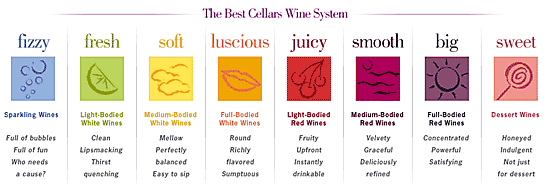
From the press section of BestCellars.com, comes a story from Wine News about BestCellars’ innovative approach to selling wine. It includes this question-and-answer:

So how did this whole thing come about?

Most wine stores tend to be organized by grape type, or country of origin. But neither of those organizational directions allow for a consumer who knows nothing about wine to be comfortable. They both presume a certain knowledge and awareness on the part of the consumer, and when you put the onus of knowing what a cabernet or merlot is on the customer, you immediately narrow your customer base. We wanted to democratize the process. We really set about making it as simple as possible.

You’ve got eight categories set up. In red wine, for example, there are “juicy,” “smooth,” “big,” each modified by several adjectives. Why those adjectives? Why those categories for that matter?

First we started looking at all the adjectives commonly used for wine. We blocked out maybe two hundred and fifty of them on cards, and then aligned the cards in broad sweeps based on attributes we thought would tie to different colors of wine. Then we started to turn over cards that needed a glossary for the average person to comprehend, the words that were understandable only by someone with a substantial knowledge of wine. Then if they were so broad that they were essentially meaningless we got rid of them. In the end we had about thirty words that seemed to work.

I love that a business model is predicated on a way of classification.

Yer Adaptive Path Update

Apologies for having so little to offer. Work has become a little… nutty (in a good way!), and I haven’t had time to think and write.

In lieu, some pointers to stuff we got going on at Adaptive Path.

Redesigning Blogger, a one-day workshop where Doug Bowman and Jeff Veen step you through how they redesigned Blogger to better explain the message, encourage registration, and do so while looking good.

Additionally, 37Signals is offering their workshop, Building of Basecamp, an in-depth look at the development of their leading-edge project management tool.

Use the discount code APDC to receive 10% off either or both days.

In other news, Scott got “Web Design: ROI Is Not a Silver Bullet” published on CIO.com. It’s very similar to what he wrote for the Adaptive Path site, though with some smart introductory text for a UX-unaware audience. Most cool is that we’re getting the value of user experience word out to the more business and tech press.

More Ways To Dispense Paper Towels Than To Skin A Cat?

As I have increased the frequency of my handwashing (best way to prevent colds!), one thing I noticed is that there is an astonishing variety of mechanisms for dispensing paper towels. You’d think it’s a pretty, well, solved problem. You’d think that, by now, the optimal solution would have been hit upon, and just used.

But no. So, I’ve gone into bathrooms and photographed some of the variety I’ve seen…

There’s everything from the spring-loaded…

…to the pull-and-tear…

…to the one that got me started, the wave-your-hand…

…and much more.

As a design-minded person, I find all these different approaches to the same problem fascinating, because they each betray different concerns. I would think that, for the user, the most optimal is the upside-down-kleenex box — easy dispening, and no need to touch anything.

But for the provider of the paper towels, they probably like the big rolls, because I’m guessing they’re cheaper than the sheets, and last longer before refilling.

I don’t know why bathrooms still have dispensers that require manipulation — touching them defeats the hygienic purpose.

And do we really need motion sensors in them? (And I find that those motion sensors tend to work poorly).

Anyway, I’d love to start a collective album of paper towel dispensers over on Flickr. I’ve developed a tag, papertoweldispenser, that can serve this singular purpose. People of earth: go into your public bathrooms, photograph your dispensers, upload them to Flickr, and tag them so they appear here! Let’s see just how many varieties there are.

Organization Centralization can be a good thing!

My essay, “Organization in the Way: How decentralization hobbles the user experience” has just been posted to the Adaptive Path site. Readers of peterme will recognize its genesis a few posts back. I was able to evolve the piece so that it spoke to a broader concern in design and user experience. I also wrote this passage, of which I’m most proud:

Ideally, these measures would balance to create a superior product. Realistically, all of those disparate objectives often conflict, leading to one of three results: 1) “design by committee,” where, in an effort to achieve consensus, innovative impulses are dampened, 2) “design by accretion,” where products are cobbled together in a serial fashion, each department contributing without regard to what the other groups are doing, or 3) “design by gauntlet,” where projects are subject to so many approval processes that they can be stalled at any point along the way.

It sounds like I would do well to read The Mythical Man-Month as it touches on some of the same problems with projects.

Ethnoclassification and vernacular vocabularies

The latest meme to catch fire in the IA community deals with the folk classification tools found on systems like del.icio.us and Flickr. Users are able to freely tag content with whatever metadata comes to mind.

Headshift provides a good overview of the issues at hand, and Alex does his thing when making sure we appreciate the good and the bad of such approaches.

I just IMed with Victor about this for a while, and thought I’d chime in with my perspective.

I touched on this topic almost three years ago in a post titled “Vernacular Thesauri,” based on a talk I saw at the 2001 ASIS Annual. Go read it. It’s about porn.

Okay, you back?

First off, I think we should drop the term “folksonomy.” No offense to Thomas — it’s a catchy term, which, I guess, is why it has caught on. It’s also inaccurate. What bugs me most is the use of the word “taxonomy.” Taxonomies tend toward hierarchy, and they tend to be imposed. Tagging does not a taxonomy make.

What we’re talking about here is “classification.” In rooting around, trying to find some prior research on this topic, I plugged “folk classification” into Google, it turns out that anthropologists have done some thinking around this, particularly with respect to ethnobiology, or how the folk approach biology, and ethnoscience.

This lead me to think that the appropriate term would be “ethnoclassification”, and when I plugged that into Google, I found “Slouching Toward Infrastructure”, a page for a 1996 Digital Libraries Workshop lead by Susan Leigh Star.

The practice of tagging on del.icio.us works because, at its heart, it’s meant for the use of the individual doing the tagging. The fact that it contributes to the group is a happy by-product… But as a tool for group tagging, it’s woefully insufficient. Del.icio.us has a very low findability quotient. It’s great for serendipity and browsing, and an utter disaster for anything targeted.

This is where Alex’s quest for a middle ground resonates with me. Being as wedded to the practical as I am, I wonder how we could put such ethnoclassifications to work in useful contexts. I’m thinking maybe an intranet, where people are free to tag documents as they see fit, but there is some librarian/IA role that attempts to provide some degree of robustness to such a scattered classification. If nothing else, this approach would be a boon to developing thesauri, particularly variant terms.

Organizational Lessons from Burning Man – Spreading Memes

Chatting with some friends who have been going to Burning Man for years, we marveled at how, even with it’s astonishing growth, the event has been able to retain it’s essence year after year. It’s remarkable that, while the experience necessarily changed (25,000 people is just too different from 250), the spirit, and what draws people to it, has stuck around. Yes a few jaded folks dismiss the more recent instantiations, but that’s little more than old-timers pining for long-lost glory days.

Anyway, in our discussions, it became clear that, among the things it has done very right, Burning Man has a small set of core principles that are easy to communicate:

– No spectators
– No commerce
– Leave no trace
(there are probably others, these are what sprung to mind).

Such simple and clear memes are easy to spread, and won’t mutate. Additionally, they’re pithy, unambiguous, and directive. They thus support dissemination to a wide audience, and can effectively prepare first-timers for what is expected of them. Any growing organization can learn from this example.