Empowering Search through Genres

Luke’s recent post challenging the design of search results pages reminded me that my original genre talk had another way to use document genres to improve the web experience.

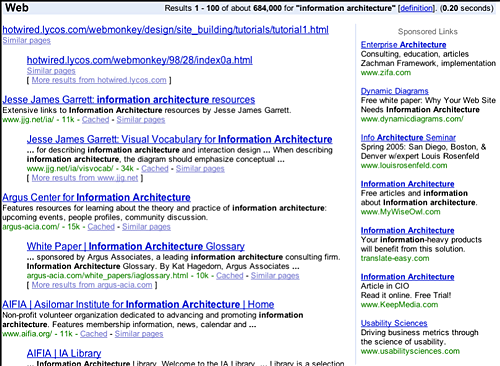
When you use a search engine, say, Google, you get a list of ordered results. So, here’s what a search for “information architecture” returns.

Search Google

Which is all well and good, if you want that particular tutorial, or Jesse’s particular set of resources. But, considering the 684,000 results, one gets the feeling that there could be more going on here.

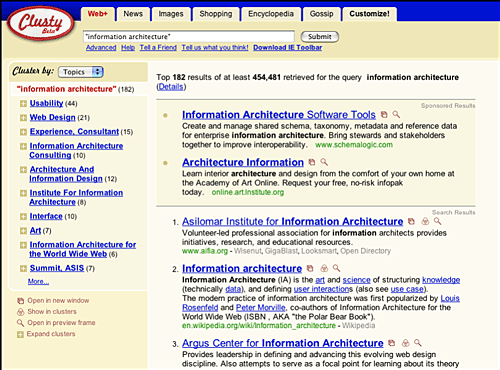
Clusty, the hideously named search engine, uses algorithmic juju to identify related topics, and presents those with your results.

Search Clusty

All right. I can’t argue that this is any better than Google’s results, because it’s unclear just how these topics are related. If you search on “information architecture” and then click “usability” or “web design,” just what are you going to get?

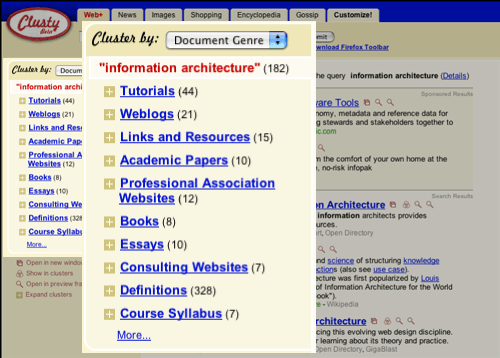
For my talk, I mocked up a Clusty interface that utilized genre as a filter:

Search Clusty Genres

The advantages, I hope, are clear. Utilizing genre allows the results to speak to whatever task the user brought to the search. If someone types “information architecture” into Google, they could be engaged in any number of tasks — self-teaching, looking for consulting help, looking for a definition, considering a career change, looking for a professional association, conducting research, etc. etc. Who knows? By offering genres as a filter, people can use that to narrow the results to those which are personally relevant at this time.

I guess it IS the content, stupid!

At the Webvisions conference coming in July of this year, I will present, “It’s the Content, Stupid,” wherein I try to remind web designers that the reason people come to their site is not for their design and architecture.

Since submitting that presentation topic, I’ve been made aware of two similarly titled essays. In “It’s About Content, Stupid,” some guy named Jeremy Pepper talks about a lot around marketing and PR. I don’t know what the title has to do with his thesis. 10 days before that, “content guru” Gerry McGovern offered, “It’s the content, stupid: search engine optimization,” where he makes it clear that the content of your webpages influences how it’s ranked in search results.

Three different discussions, all with nearly the same title.

All of which probably ticks off Gene.

Pics and Words from Hong Kong

I’ve uploaded a bunch of photos from Hong Kong so far.

This trip has been good. More jetlag than last time — we weren’t able to run around our first two days like we did before. Instead, on the day we landed at 7:10am, we had a meeting at 1pm.

We’ve eaten very well on this trip. On Friday night we headed into Lan Kwai Fong for Vietnamese food at Indochine 1929. We ordered a set menu (and ended up at the upper end of the price range in that linked review). It was way too much food, but the variety of offerings was great. The butterflied shrimp were amazing, as was the orange duck. Oh, some delightful beef. Anyway, worth checking out — but order off the menu, your wallet will thank you for it.

On Saturday we didn’t get into the city until around 3:30 or 4:00 o’clock. Very lazy going. We met up with Daniel and Jo from Apogee, a local usability firm. They took us to an excellent Sichuan restaurant. Of course, since I was just blindly following, I have no idea the restaurant’s name or place. I just know the fried chickens and chilis was excellent, though lip-numbing.


Chilis, up close

Afterward, we had gelato at XTC on Ice. While their vanilla was excellent, it was the hot chocolate, made with red chilis, that was truly memorable. If someone offered that flavor in San Francisco, the place wouldn’t be able to keep it stocked.

Today was a wander around Central, with dim sum, shopping, markets, and up the escalators.

Probably the most… arresting site was a fish for sale at the market. With it’s heart beating:

The Heart is Still BeatingClick to see on Flickr, with Note

At a store in Langham Place, I spotted this tea cup:

Which, I think, is brilliant. I don’t know what it costs — it was behind locked glass and the store workers weren’t very friendly.

Still haven’t bothered with the Peak — too dreary.

We’ve got a couple more days here. Which means, more eating!

Extending Craigslist

In 1996, I had just moved back to San Francisco. I was starting to get deeply into web design, and found myself at Brainwash with a bunch of like minded folks, shooting the breeze about HTML, GIFs, navigation design, and the like. Toward the end of the meeting, one of the people at the table said that we should all get on this great mailing list about what’s happening in San Francisco. It was pretty big — almost 2,000 subscribers — and covered all sorts of events.

That night, I joined Craigslist.

Not long after that, I met Craig (through the NoEnd mailing list), and kept tabs on the evolution of the mailing list. Well, nearly 10 years later, and Craigslist is a force to be reckoned with. Craig himself is everywhere, a symbol of everything from the power of online community to the humanity of a non-greedy entrepreneur to Public Enemy Number One of newspapers’ classified ads.

I unsubscribed from the mailing list long long ago — too many messages to keep up with. Like many, I use the service via its website, when particular needs arise.

As an information architect, Craigslist has always bugged me. A home page crammed with links, sloppy search interfaces for managing information, and little ability to truly empower the user with this information, instead choosing to overwhelm them with data.

As someone watching the develop of information technologies, I’ve wondered why Craigslist hasn’t been better leveraged. Folks utilize the data and APIs of eBay, Amazon, and Google, building whole businesses on them. Or see the amazing tools built on Flickr (Mappr, Spell with Flickr, Flickr Related Tag Browser).

Craigs Google

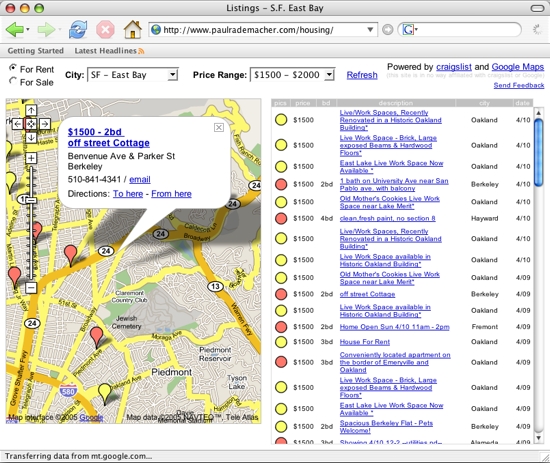
One thing currently making its way around the Blogosphere is Paul Rademacher’s Google Maps + Craigslist Housing mashup, where you use the former to visualize the latter.

I recently worked on the design of an RSS aggregator (a la Bloglines), and one of the things that becomes clear when you look at such aggregators is that they’re optimized for blog posts and news feeds. But all kinds of stuff is getting RSS-ified, including every single area within Craigslist. If someone designed an aggregator that focused on Craigslist’s feeds, and their particular kind of information presentation, you could have yourself a little business.

I wonder what else you could build on top of craigslist. Clearly, almost everything with an address (garage sale, car sale, etc.) could be mapped like the housing stuff above. Imagine a map showing all the locations of “missed connections” and see if you were there!

Or attach “consumer reviews” to the people offering their services.

Or simply provide a better interface to all this amazing information. Anyway, I think we’re going to increasingly see Craigslist data utilized the same way we’re seeing with Flickr, Amazon, eBay, and Google.

“Egg Freckles?” – Products Beware!

When Garry Trudeau mocked the Apple Newton in Doonesbury for its poor handwriting recognition, he did a lot to doom the device. At that moment, the device became unable to take seriously. So that even when it was improved in later versions, it carried with it the stigma of… mockery.

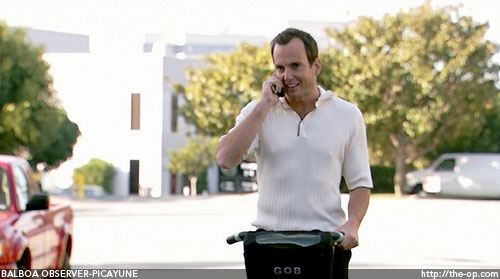
I’ve thought about that when thinking about the Segway Human Transporter. Perhaps the most hyped product launch in the history of mankind, the Segway had about a week of maybe seeming cool. Then it kind of was forgotten. But then a couple years ago, with the debut of Arrested Development, we had brilliant product placement for the Segway. It’s the way that GOB, the self-involved terribly magician, gets around.

Segway

Could we ever take the Segway seriously again?

Not All Problem Solving Involves Design

So, I was reading through my bloglines when I came across Victor’s recent post, pointing to an article about how JetBlue CEO David Neeleman’s business philosophy is influenced by his work as a (Mormon) missionary, driving a desire for equity in how people are treated. Which is all well and fine, except Victor claims David’s approach “shows perfectly how the empathy of great design thinking improves both human experience and the bottom line simultaneously.”

“Design Thinking” is a phrase that is getting increasingly bandied about, largely in an attempt to take the methods, practices, and approach of designers and apply it to other realms. A movement I’m definitely sympathetic with.

But a problem arises when we think that any “thinking” that we appreciate is “design thinking.” It’s very much in Victor’s personal and professional interest to associate the term with successes like JetBlue. But it’s also disingenuous in this case, because nothing in that piece has anything to do with design or design thinking.

Unless we think that designers have somehow cornered the market on empathy, and anyone being empathetic is utilizing design thinking. Which I think is a pejoration of the concept of empathy, and rapidly moves the phrase “design thinking” into the realm of catchy, but meaningless, buzzwords.

In fact, for all the hugger mugger around the term, I’ve found only one reasonable attempt to capture its meaning, Dan Saffer’s post, “Thinking About Design Thinking.” I think it’s a great place to start, and, if we’re able to maintain Dan’s focus on the concept, “design thinking” has potential for truly catching on.

Genres Hamper Mobile Internet

A Reuters article made the rounds 10 days ago — “Web pioneer: Design hampers mobile internet.” In it, Tim Berners-Lee decries, “Everyone was supposed to be browsing the Web with their mobile phone, but the problem is that it has not happened.”

I’ve long been frustrated by how people seem to think that content is this formless mass that you can pour into different devices, like water into different glasses. And my thinking around document genres lead me to begin articulating a framework for thinking about content in different devices, as a way to better understand why we’re not “browsing the Web with [our] mobile phone[s].”

Document genres are about how form and content come together to address a purpose. In doing so, the rely on our expectations for how that genres is designed in order to facilitate its use. When I open the envelope with my credit card bill, I don’t expect a comma-delimited list of purchases in alphabetical order. I expect a tabular list of purchases, in date order. I expect that the first page will summarize my purchases for the period, and provide a space for me to write in how much I plan to pay.

As credit card bills move to the Web, it’s important to recognize that, while serving a similar purpose, and having similar content, the fact that it is on the Web means it’s a materially different (though related) genre. I bring different expectations to how I utilize a credit card bill on the web, such as: you don’t flip through pages finding certain information, you utilize links which allow access to information chunks; the ability to call up payment history from before the period in question; etc.

In the same way that paper-based document genres evolve when they’re brought to the web, digital document genres rely on the various devices within which they’re viewed. And you can’t just take any web page, and expect it to work within any device (remember WAP?).

So, I’ve started thinking about understanding what genres work best in what devices, and why. It begins by thinking about content-related attributes of different devices.
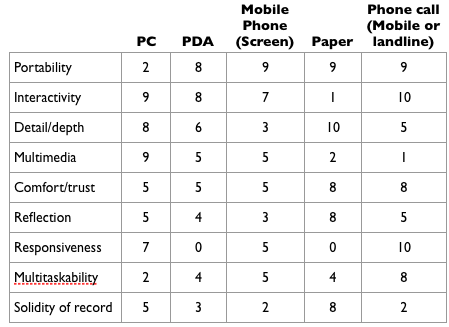
Mobile Table-1

Some terminology clarification:
Portability – the ability to carry it around
Interactivity – the ability for the device to provide instant feedback to a user’s action
Detail/depth – the amount of resolution and detail the device provides
Multimedia – the ability to utilize more than one medium at a time
Comfort/trust – generally, how comfortable and trustworthy people find a device
Reflection – the degree to which a device engenders a user to reflect on the content within. A distinction borrowed from Ellen Lupton in her essay, “The Birth of the User.”
Responsiveness – the ability, for when something goes wrong, to get an immediate response that can address the situation.
Multitaskability – the ability to do other things while engaging with the device
Solidity of record — the degree to which you can rely on the device to maintain a record of action

I graded each device on a scale of 1-10, 10 being best/highest.

When thinking about genres, the concept of “purpose” gets foregrounded. And when thinking of purpose, of the task at hand that someone is trying to accomplish, we realize that purposes/tasks require an appropriate degree of these attributes.

Let’s take the long and involved process of buying a house. Looking at some steps along the way, we can get a sense of what tasks require what attributes… And what that says about where document genres are best suited.

So, when you’re choosing houses to check out, that task has certain attribute requirements.
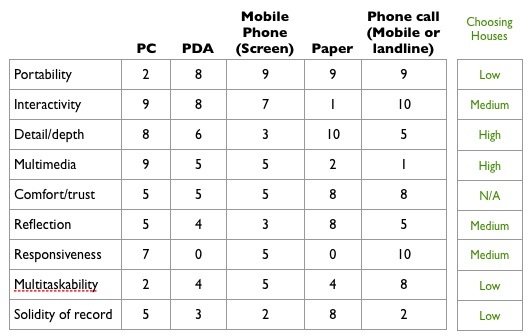
Genre Choosing

You don’t want to waste your time visiting a house that’s not suited to you, so what’s most important is to get a lot of information, and information that *shows* you the house — photos, videos, QuickTime VR. As you rank the importance of each attribute for the task, and then look across the table, you realize that PCs are exceedingly well-suited to helping people choose houses. It shows why we’ve gone so quickly from super-brief classified ads to media-rich web pages in a very short time.

How about much later in the process, when you’re applying for a mortgage?
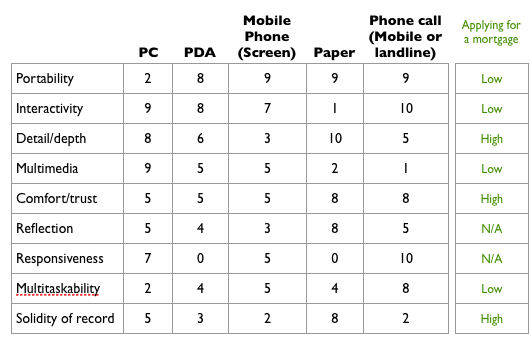
Genre Mortgage-1

The chart suggests why applying for mortgages is still largely rooted in the world of paper — the crucial elements of comfort/trust and solidity of record. But those are cultural attributes… and you can see that PCs are not all that far behind, and those numbers will doubtless rise over time.

That’s enough of this for now. In time I’d love to figure out a way to make this more rigorous, and come up with some methods for taking advantage of this.