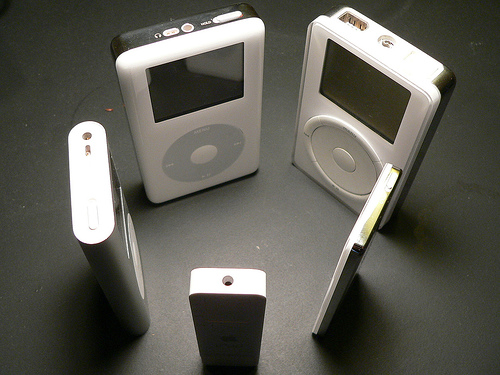
Photo from here.
The Design Observer recently featured a sloppily-written article on why Apple is bad for design. Seeing the post’s title, I eagerly expected a thoughtful critique of that most vaunted of companies — nobody’s perfect, and there must be reasonable things to comment on. Instead, the DO article is an incoherent rambling on issues of form, style, and rounded corners, and ends up as much ado about nothing.
I thought, well, I could do better than that. So here I go.
The main reason why Apple is bad for design is that they’re a highly idiosyncratic organization. As such, it’s nearly impossible to copy them, because no other organization has the elements that allow Apple to product great design. This means that when others do try to copy them, they focus solely on the superficial aspects of the design.
I would argue that the main reason Apple is bad for design is because they’re so secretive about their work. So, while they benefit design because they demonstrate the value and power of design in the marketplace, they prove a detriment to design because they don’t share how they achieve such brilliance.
And because they don’t share, they make it look too easy. If you dig deeper, and listen to the stories of what it took to get iPod (all the iterations on form, as mentioned in Steven Levy’s The Perfect Thing), or iPhone (two and a half years to get it to market), you know that it’s not easy. But that hard work is lost on many, and the seeming simplicity of the end product suggests simplicity in the process. Which leads to people coming to Adaptive Path, and saying, “We want to be the iPod of [product category],” without any understanding of the deep commitment that it takes to get there.
If Apple were to share, we’d understand the tradeoffs that go into the decisions they make; the countless attempts before settling on a solution; the obsessive attention to detail, often at the expense of the bottom line; and doubtless other things that I know nothing about. And other organizations would then appreciate what it really takes in order to be a design-led organization, and, hey, that would be great for design.
(Now, it might not be great for Apple, but that’s not what we’re talking about.)
Apple is bad for design because they contain a brilliance that simply cannot be emulated. And that brilliance allows them to approach design in ways that are harmful for those organizations that aren’t brilliant. Dan, in his book Designing for Interaction, holds up Apple as an example of genius design — design that emerges from the mind of the designer. This is in contrast to user-centered design, systems, design, and activity-centered design, which all incorporate users more directly.
So, this could encourage other companies to practice genius design. The problem is, the people at those companies aren’t geniuses. Steve Jobs is a genius (and has had it proven numerous times throughout his career). And when non-geniuses practice genius design, bad things happen. Instead, what’s good for design in the overwhelming majority of cases is more of a user-centered approach, because this approach is accessible to many more people, and thus could have a much broader impact on design.
Hrm. And now I’m a little stumped. Because, in sum, I do think Apple has been quite good for design. Could it be better? Sure. Have design and designers benefited from Apple’s success? Definitely. I’d love to hear your thoughts on why Apple is bad for design…


