Steve Portigal and I are the visiting dignitaries of a Pub Meetup taking place 4 September at the John Snow. Details on Upcoming.
Category: Uncategorized
Heading to London and Brighton, 2-9 September
I’m speaking at d.construct on 6-7 September, and in an effort to make a trip out of it, I arrive in London on 2 September. I’m hoping to line up some working meetings while I’m there, so if I should come on by, email me and let me know (peterme AT peterme DOT com).
Beyond The “T” – Coordinating Realistic Design Teams
It’s not uncommon, when talking about designers and what to hire for, you hear about “T-shaped people.” IDEO is most commonly identified with this, wherein you hire people with with a strong “vertical leg” in a specific skill, and an empathy that allows them to branch out and engage other disciplines.
Yesterday at Adaptive Path’s UX Week 2007, I sat on a panel on “Skills for Current and Future User Experience Practitioners”. As the conversation evolved, we started talking about design teams. Through the discussion, I had a lightning storm in my brain, where I realized that “T-shaped” is insufficient.
Let me step back a bit. I have long had issue with the fetishization of “T-shaped” people for the simple reason that I’m not T-shaped. I’ve never been able to articulate my “vertical leg”. Throughout my career I’ve moved from activity to activity, from web development to interface design to information architecture to user research to product strategy. And I think my success is due to my ability to understand the synthesis across these skills and disciplines, to appreciate how to orchestrate them, to know how these integrate to achieve optimal affect.
So, where do I fit, if I’m not T-shaped?
On the panel, and, honestly, this idea germinated as I was sitting on-stage, I realized that you don’t necessarily want a team of all T-shaped people. The reality of the world is that you have T- and I- and bar-shaped people, and I suspect that the strongest teams are comprised of all three that work in concert. Me, I’m a bar-shaped person. I’m all about the connections between disciplines, and being able to articulate the power of that integration. Obviously, T-shaped people are important, too, people who can bridge that synthesis and go deep. But perhaps most important is that we no longer marginalize I-shaped people. It’s easy to dismiss I-shaped folks, people who simply want to focus on, geek out to, their particular passion. But these people can be amazing on teams, because once you give them a bit of a direction, they can do amazing work.
Anyway, I think it’s unreasonable to expect to live in a world of T-shaped people, and, honestly, it’s remarkably limiting. Let’s instead figure out how to coordinate across different types of creative people, ideally realizing a whole that is greater than its parts.
This is a subject I think will come up a lot at Adaptive Path’s upcoming MX Conference, taking place October 22-23 in Philadelphia. If this topic resonates with you, I encourage you to attend! (Use promotional code FOPM to receive 15% off the registration fee.)
Lookit that! iPhone knows I’m a grown-up!
Earlier today I learned that iPhone’s internal dictionary corrects typos of “shit” and “fuck”. I’m guessing there are two reasons for this. 1) Steve Jobs swears, and probably swears in his written correspondence, and no spell checker is going to give him a damn red squiggly underline when he’s using perfectly good curse words. 2) Apple assumes its users are adults, and if they want to swear, they’re not going to make the user feel needlessly uncouth by claiming their perfectly good words are “misspelled.”
(Mac OS X also recognizes “shit” and “fuck”.)
It seems like a small thing, but it’s an important detail in the design. Nearly every other computer system refuses to recognize curse words, and, in effect, condescend to their users. Apple, by recognizing the reality of English discourse, exhibits respect for their customers.
Gobbling… an emerging paradigm?
[I know I haven’t been very active here… I’m not leading a life of the mind so much of late… Very much caught up in what it takes to help run Adaptive Path, which is very much a matter of rolling up sleeves and simply getting things done. All that said…]
So, I’ve been involved in an actual project lately, working in the world of financial services. A big challenge that users have is overwhelm, particular when it comes to investment choices, account types, and the near infinite permutations of the two. We realized that people need to be able to easily save/store/set-aside such choices and account types, so that they can come back to them later, or be able to manipulate them free from the rest of the site experience.
The approach we found ourselves moving toward was akin to the Yahoo Gobbler explained by Bill Scott a few months ago, which is similar-ish to Google Notebook.
And thinking about it, and thinking of the overwhelm that people increasingly face trying to get things done online is making me feel that the Gobbler paradigm is likely emergent, particularly with Ajax enabling a seamless interaction with such a tool. I wouldn’t be surprised if we see gobbling functionality provided across a variety of sites.
October Is Conference Time
Two events I’ve had a hand in programming take place this October.
At the beginning of the month (October 4-5) is the IDEA Conference, our second go at an event about the design of complex information spaces of all kinds. Last year’s event was amazing (listen to talks and view presentations here), and this one could possibly be better! We’re doing a lot to emphasize New York City this time around (as it’s our host), and that focus should prove intriguing. Shit, we’ve got someone from 311 speaking!
Then later in the month (October 22-23) is MX East, Adaptive Path’s conference on managing experiences through creative leadership, where we focus on what it takes to get great experiences out into the world (hint: it’s not just great design, nor brilliant strategy). The first MX sold out, and we’re expecting this to do the same. We’ve got an amazing slate of speakers (I’m particularly thrilled by Joshua Wesson, CEO of Best Cellars, a company I’ve been writing about here at peterme.com for 6 years!), and the event is produced by Procreation Design Works, who produce a little event you may have heard of called TED.
I hope to see you some time in October!
Radio with heart
Walking to BART, I listened to this story about a 17-year-old girl who does a lot to take care of her autistic younger brother (in large part because her parents don’t speak English) It was a little awkward, because my eyes teared up. It’s a remarkable story. Listen for what her younger sister has to say.
Talented bad web design
In the early days of the web, it was common to find examples of really bad web design done by obviously talented designers. As folks were learning the medium, they tried all kinds of things, many of them which lead to terrible experiences for users — overwrought splash screens, clever interfaces too difficult to use, aesthetics and style placed above utility, etc.
Since 2002 or so, though, these kind of site experiences have pretty much disappeared. As we all figured out what it meant to put together a basically good site that didn’t screw things up, it’s become harder and harder to find examples where otherwise talented creative folks have totally screwed up. This has made teaching web and interaction design harder, because it’s these examples of design that serve as great tools for instruction.
Which is why the site for the 2007 PDMA conference is so interesting. The Product Development and Management Association is perhaps the leading professional association for folks in its field. It’s a world that Adaptive Path has been getting closer and closer to as we shifted our focus away from marketing and toward product development, particularly product development that makes sense for the people using those products.
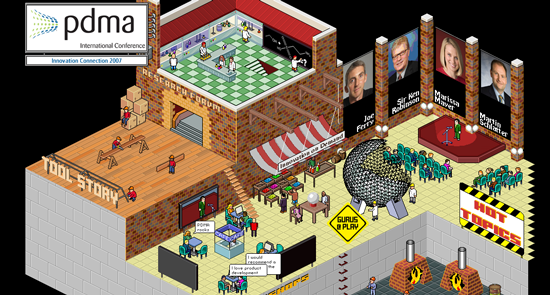
The website of the conference is a disaster. Or rather, the home page is a disaster. It is a giant flash movie, done in an-eBoy-like isometric pixelated style. And it’s impossible to figure out what to do. Originally, I went to that page looking for the date of the event. It’s nowhere on that screen that I can find. And I couldn’t figure out just where I should click. Nor do I know what the following phrases mean, all used on the page: “tool story”, “gurus @ play”, “research forum”, “innovation on demand.” I also found out that if you click in the pool, you go to “workshops.” I don’t know why there’s a geodesic sphere, or kilns. I had no idea where to click to get a simple overview of the event, with, you know, IT’S DATE.
Anyway, I don’t mean to be a Scrooge and all, and really, I do like fun and play in my web experiences… where appropriate. I realized I had a hard time taking this conference seriously if this was the way they were going to showcase it… What does it say about the philosophy of product development on display?
Please someone please make a t-shirt from this
There was a man whose tears could cure cancer. His name was Jesus, not Chuck Norris.
— Chuck Norris
From here.
The World as Game, continued
A bit back I wrote a post, All the World’s A Game, about how all manner of aspects of life are turning into games, whether it makes apparent sense or not. And now I just read about Chore Wars, a way to make doing chores fun, by creating a game-like competition around them.
I must say, I absolutely love the illustration on the Chore Wars homepage.