I wore goggles, too

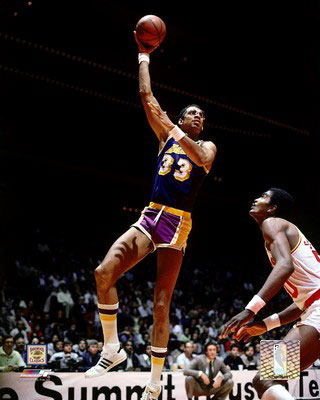
Aagz061 8X10~Kareem-Abdul-Jabbar-Hook-Shot-PostersI grew up in Los Angeles in the 70s and 80s, and basketball was my favorite sport to watch and play. Needless to say, the L.A. Lakers were my team, and its centerpiece Kareem Abdul-Jabbar my favorite player. To the degree that when I would play b-ball with my friends, and we’d pretend we were professionals, I always said I was Kareem. Though I was an exceedingly average-sized white kid. The only thing we had in common was that I wore goggles when I played (I wore glasses until I was around 12). And I shot a skyhook, though it rarely went in.

As I’ve grown up, I’ve learned that Kareem is a rarity in the sports world… A gentleman athlete, well-read, well-spoken, and, to his credit, *outspoken*. He changed his name from Lew Alcindor because of what he fiercely believed in.

Now, I see that Kareem is blogging for the L.A. Times. And if you look at his recent posts, he’s clearly a gifted, engaged, yet humble man.

UX Week 2008 – New site, impressive schedule

One thing that’s taking much of my time at Adaptive Path is programming our upcoming UX Week 2008 event. I’ve been trying very hard to balance inspiration and information; visions of where we’re headed mixed with practical how-tos.

As such, we’ve got people you’d expect, like Don Norman, Jeffrey Veen, and a coterie of fellow Adaptive Pathers, and then people you might not expect, like Scott Griffith, the CEO of carsharing service Zipcar, alternate reality game designer Jane McGonigal, Wiimote hacker Johnny Lee, human-robot interaction engineer Aaron Powers.

We’re also trying something new, with 2.5-3 hour afternoon workshops on Day 1 and Day 2. Workshops range from skills-building user experience practice around prototyping, design research, and team processes, to slightly out-of-left-field sessions on information visualization, storytelling taught by avant garde thespians, and designing for gestural interfaces like the Wii or iPhone. Priority selection is based on order of registration, so the sooner you register, the greater the likelihood you’ll get to exactly the workshop you want!

Also, it wouldn’t be an Adaptive Path event without a field trip to a museum, and this year we’ve got a doozy — The Exploratorium! We’ll learn about the design of exhibits (and how they consider the visitor experience), and then blow off some steam in their amazing space.

UX Week pricing goes up March 31st, so register now for the best deal. And if you use promotional code FOPM, you’ll get 15% off!

33 out of 36

After scoring 24 out of 80, I explored the other tests on the site. One that caught my attention is the Mind in the eyes test, which asks you to describe what someone is thinking or feeling based just on looking at their eyes. I believe it’s related to Paul Ekman‘s work on reading faces.

Anyway, on that Mind in the eyes test, I scored a 33 out of 36.

So, I have little innate empathy, but I can read other people’s expressions remarkably well. I don’t know if this is contradictory, or if it’s exactly right. Perhaps empathy and facial reading are just to very different parts of the brain.

24 out of 80

A little bit ago I answered a set of questions meant to measure my empathy quotient.

I scored 24 out of 80.

That placed me in the “low” category, according to the test:

0 – 32 = low (most people with Asperger Syndrome or high-functioning autism score about 20)

I’m thinking of getting “24 out of 80” tattooed on my arm, or emblazoned on a t-shirt.

The latest issue of Wired – articles worth reading!

I’ve been disappointed with Wired for, oh, 10-12 years now, but the latest issue had three articles that deserve your time.

A psychologist who is competing with math and stats nerds on the Netflix challenge. Social science reprazent!

Chris’ article on Free! I love that he’s able to use Wired as a venue for launching future bestsellers. Though, honestly, I might have preferred the podcast of his presentation on the topic.

My favorite, though was an article on new thinking about autism, representing the views of autistics who say they’re not damaged, just different. I wrote about the two featured autists in a post last year.

Ubicomp happens

The latest issue of Interactions magazine features an article titled “When Users ‘Do’ The Ubicomp,” (subscription required to read the whole thing) which is the first academic-ish article I’ve read that addresses ubicomp the way I think about it.

Ubicomp futures tend to be portrayed as planned, coordinated, intentional, purposeful connections between the devices in our lives, chips embedded in our environment, utilizing protocols to interact with one another.

What the article points out is that ubicomp is here (you carry a mobile phone? smart phone? laptop? use a desktop computer?), and it’s messy, and uncoordinated. When I think of our Glorious Ubiquitous Future, I see the evolution of the messy uncoordinated technologies… I suspect the best plan of action is on the standards front, so that there’s some kind of unplanned but enabled interoperability, so that these components can work together in ways that haven’t been foreseen. This is the magic of open APIs on the Web, and that spirit will help as we move forward to situated contexts.

MX 2008 – Giveaways!

We’re trying something new this year with the MX 2008 Conference… We’re GIVING THINGS AWAY!

To remind you — MX is our two-day confab on the emerging discipline of creative leadership, and has perhaps the most stellar collection of presenters we’ve ever had. It’s designed for people who’ve been around the user experience block quite a few times, and looking for new sources of information and inspiration.

The first thing we’re giving away is books. All attendees of MX become members of the MX Book Club. The first two books you’ll receive are Chip Conley’s PEAK and Chip and Dan Heath’s Made to Stick.

The second thing we’re giving away is an iPod Shuffle. Everyone who registers between now and March 31st will receive an iPod shuffle. Shiny!

And we’ve just announced that one person who registers between now and 11:59pm (Pacific time) on March 14 will be selected at random, and given their choice of one round trip ticket anywhere Virgin America flies OR a spa/massage package at the Mark Hopkins, the conference hotel.

So what are you waiting for? Register now!

The fluorishing of post-apocalyptic stories

I’m reading Earth Abides a post-apocalyptic (virus wipes out nearly all humanity) novel from 1949. I mentioned this to Matt, who pointed me to this post, “What’s Causing the “Earth Without Us” Craze in New Scifi Movies?”

Annalee posits stuff I’ve heard elsewhere, but reading Earth Abides made me realize another one. Earth without us, or, at least, without nearly everyone, is consumer heaven. If you saw I am Legend, you saw Will Smith have his choice of anything item he wanted. You actually see this in Earth Abides. Americans love to consume, and when you have no competition for stuff, when it’s no longer scarce, and when you don’t have to pay for it, what could be better?

Another thought on TED

I only just realized that TED featured no “business people.” There were people in business, but no CEOs who are known for being CEOs, no grand business leaders, those types of folks. I find that a curious omission. I don’t know if it’s purposeful. It strikes me as a potential oversight — businesspeople have many “ideas worth spreading” (I’m thinking specifically of Chip Conley, CEO of Joie de Vivre, (who in turn mentioned Paul Hawken in my discussion with him).) Though, it’s also indicative of the typical shallowness of “business” discourse.