My obligatory iPhone post

I don’t know what I can add to the discussion around Apple’s latest unveiling, but I feel obliged to say something.

In 1993, Apple released the Newton. This was CEO John Sculley’s big dream project. It was going to be his Macintosh. However, from a standpoint of market acceptance, it failed.

Now, Steve Jobs loathes John Sculley. He’s been quoted saying about Sculley, “”What can I say? I hired the wrong guy. He destroyed everything I spent 10 years working for; starting with me, but that wasn’t the saddest part. I would have gladly left Apple if Apple would have turned out like I wanted it to.”

So, I just get the sense that, every step in the 2-and-a-half year development of iPhone, Jobs had this bone to pick with Sculley, and that Jobs’ portable computing device was going to be nothing short of “insanely great,” and that at every step, he was determined to not just surpass, but blow away his predecessors.

Because, that’s the thing with the iPhone. Everyone knew it was coming. No one knew how it was going to transcend their expectations. It is such a quantum leap forward, not just for a phone, but for the whole field of consumer electronics, and I don’t think we’ll understand the implications until a good year or so after its release.

Other thoughts

This is a remarkable Trojan Horse on the whole netphone front. Yes, it’s a GSM mobile phone and there’s an exclusive deal with Cingular. But also, it’s a mobile wi-fi device, and so, why use Cingular if you can just Skype?

2 megapixel camera — impressive. But does it only have still picture capability? Considering they’ve put an iSight in everyone of their computers, I’m surprised that iPhone doesn’t have a video camera built in.

I drop my mobile phone with some frequency, and my iPod occasionally. How rugged is this device?

It’s a little strange that they ended up calling this “iPhone,” considering it’s essentially a small tablet PC. I mean, it probably makes sense from a marketing perspective, but I’m curious as to what happens when “the street finds its uses” for the device. I wouldn’t be surprised if phone calls is not the primary function.

Quick Review: Letters from Iwo Jima

I’m appalled at the near-unanimity of the glowing reviews for Letters from Iwo Jima. We saw it a couple of days ago, and were left with one strong, overriding, feeling: boredom.

It is an overwhelming trite and surprisingly rote war movie. You know everything that is going to happen, not just the big things, but the little things as well, long before they occur. I suspect Eastwood was simply overwhelmed by his subject matter. Unlike Million Dollar Baby, which interestingly upended notions of The Boxing Movie, Letters from Iwo Jima seems too daunted by the Epic Realities of War to deliver anything that isn’t cliche.

I can find one review that captures my sentiment.

Adaptive Path-related activity.

First off, a reminder about Adaptive Path’s MX–San Francisco conference, addressing issues around managing experience through creative leadership. We’ve just posted an excellent brief interview with IDEO’s CEO Tim Brown, who will be keynoting the second day. Register by January 15 and save $200. Register with promotional code FOPM and save an additional 15%!

Also, I posted on the AP Blog about how experience design is not about brands, and that conflating them does the notion of customer experience a disservice.

Also also, the talk I gave in Chile, “Beyond Transactions: Experience Strategies for Financial Services” has been posted. View the slides, listen to the audio (neither makes sense without the other.)

AskCity: You Know, It Doesn’t Suck

At the beginning of this month, the New York Times featured a story on the CEO of Ask.com, Jim Lanzone, focusing on the recent launch of their regional information search, AskCity. Over at the AP blog, I quoted Lanzone from the story: ““Right now, the focus is almost entirely on improving the user experience. This is the product that, to date, we are the most proud of. It is going to have a huge impact for people who use Ask.”

AskCity is an attempt to regain market share in the search space, as local searches “account for 10 percent of all Internet queries,” according to the article. This also puts Ask square up against Citysearch, Yahoo! Local, and Google Maps/Local, and in a space that feels pretty saturated.

I often have cause for searching local information, particularly related to restaurants, so I tried out AskCity for some of those searches. And you know what?

It doesn’t suck. There’s some nifty functionality in there to improve the local search experience. A search for “romantic restaurants” in “san francisco” returns a number of solid results. Clicking on a result takes you to a special page, which pulls information from a variety of sources, including Citysearch (owned by Ask’s parent, IAC), Yelp (not owned by IAC), and others.

It gets better though. A friend needed recommendations for restaurants near the Opera House, the trick being she was going to the Opera that night, and had been delinquent with reservations. I used AskCity to find restaurants, and, and this is where it gets interesting, was able to “pin” the restaurants, causing them to stick in my listings, and on the map, while I kept looking for more. Even if conducted a new search, pinned results remained. In this way, I located about 6 different places.

But how would I get them to her? I could email her separate links, but AskCity makes it easy to email whatever map you’re looking at. You can see such a map here. (This *should* work in all browsers, but can be wonky…)

But that’s not all! Because you can also annotate the map with drawings and text. So, let’s say I have a favorite place to look for parking in that area. I can show it like I have here. (Browser caveat repeated…)

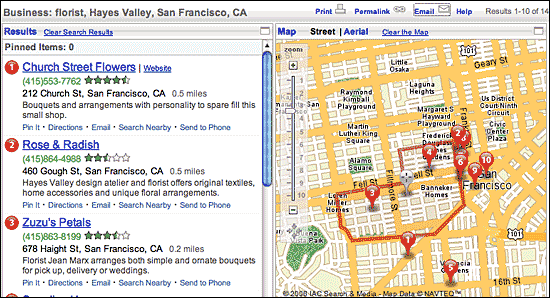
Now, there’s one more bit of coolness. Let’s say you wanted to buy your dates some flowers before the show. In AskCity, you enter “florist” in “businesses” and “hayes valley, san francisco” in location. You’ll get the same kind of results, but look at the map — there’s a red outline showing the boundaries of the Hayes Valley neighborhood.

Ask Neighborhoodmap

This might be the first time you could search *neighborhoods* in a local search engine. The neighborhood data happens to be powered by UrbanMapping (whose CEO, Ian White, spoke at my IDEA conference). I don’t know how robust the neighborhood database is, but try it out in your city — it’s an interesting option when looking up local searches.

AskCity is now a stable in my search repertoire, and is oftentimes the first place I look before heading onto CitySearch, Yelp, and the like. Kudos to Ask for truly innovating in a space that needs it.

What will Ubiquitous Personal Video lead to?

A few weeks ago, Youtube launched the ability to directly grab webcam feeds and upload them (login required) — no intermediaries.

Also around that time, I, and millions of others, bought MacBooks, each of which has an iSight camera built in. So, what are the opportunities that such Ubiquitous Personal Video offers?

Video chat is an obvious answer. But less obvious (at least to the hearing community), is how deaf people use Youtube to communicate. How does video allow for new markets for the deaf, or maybe those having trouble with written language?

We’ll also see a proliferation of software that uses video input, like the Delicious Library, which “scans” UPC symbols captured by a camera. What will it mean now that it’s so easy to catalog everything you own?

Video games such as Freeverse’s Toysight, that integrate physical input captured on video, will become more prevalent.

Will we start seeing gestural interfaces? I wave my hand in certain ways and things happen?

Who knows exactly where it will all lead, but we no need to seriously consider video not as output, but as an input device. That makes things interesting.

The Branding of Polaroid

Doing some research on the history of photography lead me to “The Branding of Polaroid,” a remarkably detailed look at the development of the Polaroid brand, by a principal instigator. It’s rich with stories, images, and perspective — there’s enough content for a small book! It’s a bit tricky to navigate — use the “chapters” listed under “Archives” to go from beginning to end.

Update: I just remembered this page on the evolution of Kodak’s brand logo. It’s fascinating to see it improve until 1971, at which point it seems to backslide, with the numbingly bland mark they have now:

interesting : important :: novelty : everyday

Ryan, pointing to a post by Matt, comments briefly: “… when we’re at our best, we shun novelty and design the everyday.” It reminds me of a comment Bruce Sterling made in his closing talk at IDEA (MP3), where he implored designers not to pursue and fetishize that which is interesting, but to engage in what is important. This is hard for designers to embrace, but it’s true.

In talking to Ryan about this on IM, I realized that this might be what’s at the heart of my struggles with the Design Community since I joined it. I addressed this is my (very long) conversation with GK van Patter, “…I’ve spent much of my career fighting small-minded design thought, particularly in the world of graphic design where the cool, novel, and stylish is lauded over the useful, usable, and truly deeply engaging. I have to point no further than the “interactive” design annuals published by the likes of Communication Arts or Print, which celebrate pretty screenshots instead of tools that solve real problems.”

The Experience of Disneylandâ„¢ Resort

Yesterday, Stacy and I went to Disneylandâ„¢ Resort. Her first time ever, my first time since, I think, Grad Night in 1989.

Since I last went, I’ve become a bit of a design geek. And now work for an “experience strategy and design” company. And Disneyland is definitely a standard-bearer when it comes to experience design. At least, one form of experience design, quite literally an experience-on-rails design, where the point is to direct the audience to very specific experiential outcomes. (As opposed to, say, user experience design, which expects the user’s motivations and behaviors to significantly effect the experience.)

My biggest fear was that the park would be totally crowded — as you head into the holidays, people on vacation fill the place up. Happily, going on a Tuesday 6 days before Christmas proved wise — we never waited more than 25 minutes for any ride, and many rides had only 10-15 minute waits. (I remember hour-plus waits from my childhood.)

Grades and thoughts on the rides we went on

  • Buzz Lightyear Astro Blasters
  • Grade: B-. I didn’t know this ride existed until we went in the park. As fans of the Toy Story movies, we decided to give it a shock. It’s essentially a slow-moving immersion ride combined with a shooting gallery, where you try to save the universe (or something) from Zurg. It didn’t suck, but I did feel that the “interactive” aspect deterred from the experience — I was so focused on zapping little Z’s with my ray gun that I didn’t really engage with the ride’s narrative.

  • Disneyland Railroad
  • Grade: B. Walt had a fascination with transit, demonstrated by the multiple ways you can get around the park. For what it is, the Disneyland Railroad is a perfectly fine respite from the clamor of the rest of the park. The “Grand Canyon” bit is a bit bizarre (it’s so poorly rendered), though the dinosaurs were kinda cool. This is the only ride that really exposed the seams behind the park — shortly after we got on (in Toon Town) we passed a service area, with stuff stacked in plain sight that should have been hidden.

  • Enchanted Tiki Room
  • Grade: B. “In the Tiki Tiki Tiki Tiki Tiki Room…” For sheer goofy pleasure, this attraction (not a ride — you just sit in a room) is quite charming. Audioanimatronic birds and statues sing a medley of songs. My only disappointment — at the start of the show, the Cast Member introduces it with what was essentially an apology about how dated the audioanimatronics are, but without them, we wouldn’t have great rides like Pirates of the Caribbean. You don’t start an experience with an apology. Just like the Room be the Room.

  • Haunted Mansion Holiday
  • Grade: C. In my memory, the Haunted Mansion is among my favorite rides at Disneyland. It had a delightfully fun and moderately macabre sense of humor. I didn’t know about this “Haunted Mansion Holiday” until we approached the ride. It seems that for the last three months of the year, the Mansion is taken over by a “The Nightmare Before Christmas” theme, with Jack Skellington, Zero, Sandy Claws, and all. Well, I don’t like it. And I don’t think I don’t like it just ’cause it’s a change. I think I don’t like it because it’s just so out of place. “Nightmare” is not a house-centered concept, and wedging that world into this one leaves both wanting.

  • Indiana Jones Adventure
    Grade: C. This was totally new to me, and I had no idea what to expect. It’s a moderately thrilling ride, where you’re in a Jeep, careening through sets inspired by the Indiana Jones movies. It suffers from the same maladies as so many Hollywood blockbusters–charm and emotion is replaced by crass spectacle and special effects.

  • It’s A Small World Holiday
  • Grade: B. This endures the “holiday” makeover far better than Haunted Mansion, if only because the music is altered to include Christmas carols, so you don’t have that one melody relentlessly drilled into your head. It’s heard to impugn It’s A Small World — you get what you come for — but I was surprised at how no attempt was made to hide the ceiling. Disneyland is typically so good at making their rides all encompassing, but here, you see the boring tiled ceiling plain as day.

  • Jungle Cruise
  • Grade: B. One of the originals. It’s notoriously flaky from a technical standpoint, and was inoperable when we first went by. So we didn’t ride on it until night time, which requires the use of lights on either side of the boat to see everything (and I suspect you miss many details). Still, a silly little ride down a river, with some expertly rendered audioanimatronic animals, and bad bad bad puns from your boat guide.

  • Matterhorn Bobsleds
  • Grade: C. A lame roller coaster. Does provide a nice view of the park, though.

  • Mr Toad’s Wild Ride
  • Grade: B-. This was the only storybook kiddie ride we went on. It’s okay.

  • Pirates of the Caribbean
  • Grade: A-. Still my favorite park experience. It’s so rich, through and through. Some of the sanitizing that’s happened since I last rode it is a shame, but is also made up for by the addition of an audioanimatronic Jack Sparrow that is *crazy* lifelike.

  • Space Mountain
  • Grade: B+. Stacy’s favorite ride. It’s a roller-coaster. In the dark. With lights acting as stars and comets and galaxies. It’s a pretty tame roller-coaster, as such things go, but fun all the same.

  • Splash Mountain
  • Grade: B. I ended up liking this more than I thought. Loosely based on “Song of the South,” which I’ve never seen, the whole ride is an excuse for the final plunge where, most definitely, you will get wet.

  • Star Tours
  • Grade: B+. Star Tours has probably the best queue of any attraction in the park. Knowing that people could be stuck a while, they filled it with things to look at. I love the space tourist travel conceit, see the robots at work is fun, and they even did a good job with the pre-boarding announcement. The ride itself still works well, though it definitely is starting to show its age (expected after 20 years).

  • Thunder Mountain Railroad
  • Grade: B-. A roller-coaster type ride.

    Some Other Thoughts

    So, you know how Disneyland doesn’t serve alcohol? (Well, except at 33, and I wasn’t getting in there…) I wouldn’t have minded if they didn’t feature alcohol so prominently on so many rides… Pirates is obvious, but there are jugs with “XXX” on it on both Splash Mountain and Thunder Mountain, and, perhaps most oddly, booze plays a prominent role in “Mr Toad’s Wild Ride.” After all that display, you can’t help but want a drink.

    So clean! I know it’s one of Walt’s founding tenets for the park, but still, it’s remarkable. Not only are there trashcans everywhere, there are folks with brooms everywhere, too. Stacy thought another contributing factor was one of social pressure — it’s so clean, don’t you want to keep it that way?

    So small! Disneyland covers surprisingly few acres for all that it packs in there.

    Arriving at around 9am, we had planned to spend the entire day there, well into the evening. But, because the lines were so short, we found ourselves pretty much done by around 5pm. We stuck around a bit to see what the park looks like at night (It’s A Small World is pretty awesome), and then headed out around 6.

    Downtown Disney, just outside the park, was disappointing. We were two thirsty and hungry people in search of a drink and maybe a meal, but no restaurant appealed. We got a drink at Uva, a pleasant outdoor bar, and left.
  • Unfinished thoughts on user research

    I’ve started a bit of a discussion within Adaptive Path on the subject of design research, and my concern that designers are flocking to research as a way to not have their work so coldly scrutinized. I just wrote up an email to an internal list trying to capture my thoughts, and have realized that it’s to muddled even for the AP blog, so I’m posting it here, because, well, I look to my readership to help me figure out when I’m making sense and when I’ve lost it.

    I think it goes without saying that I support user research. I love the insights that we’re able to develop, and I do believe it often leads to superior designs. I have no desire to cast it aside.BUT, what I am reacting to is a trend I’ve been witnessing.

    I talk to a lot of designers, both in-house and in the community, and a common thread of late is how much they love research. With a very definite implication that they’re less interested in design, and instead want to focus on how research frames the problem of what to design. I even get a sense that many feel they have grown beyond design, that they’re kind of pooh-poohing the craft of design, that they want to focus on more strategic concerns now.

    My concern is that I think this desire to shift toward research is often motivated by research’s lack of accountability. Design is easy to criticize, easy to test, easy to measure. It is relatively straightforward to determine a design’s success (even if that success is determined subjectively by the key stakeholder). Research on the other hand, is hard to criticize, hard to test, hard to measure. The results of research, typically some understanding of the audience and a plan that takes advantage of those insights, aren’t held up to such scrutiny.

    I fear this emphasis and idolatry of research, for two reasons. First, it loses sight that research is simply a means to an end — that end being to deliver results. Second, if research doesn’t demonstrate explicit value, it becomes a target for line-item- removal, particularly when things get rough.

    Perhaps a tangent, but I think a revealing one, comes from a discussion I had with Jared Spool, when I interviewed him for our website a bit back
    =====
    PM: What are typical mistakes, or misguided notions that you see when observing others engaged in user research?

    JS: I think probably the biggest thing is not understanding the difference between observation, inference, opinion, and recommendation. Those four things are quite distinct and independent of each other. And if you don’t realize there’s a difference, you tend to muddle them up, and then things get very confusing.
    =====

    In the full transcript, Jared defines them essentially as:

    • observation: what you saw (the user clicked a link)
    • inference: why you think something happened, usually because of causality (the clicked a link because they thought it would take them where they wanted to go)
    • opinion: a statement about the situation based on inferences (the link has a confusing label)
    • recommendation: how to change the situation to achieve a goal (the link should be renamed as ______)

    You pretty much have to twist Jared’s arm, or give him lots and lots of money, to make recommendations. Because he doesn’t want to give recommendations unless he’s pretty certain they will lead to the desired change. Which means he needs to collect *tons* of data to give him that confidence. This might seem awfully reductive, but I think it is key, because it makes his research findings *accountable*.

    I’m going to leave it at this for now. I’ve probably already blathered too much.